NSN
slider image
  • Home
  • Conversations
    • Industry Conversations
    • All Conversations
  • Perspectives
    • Education
    • Emerging Technologies
    • Government Initiatives
    • Industry
    • Industrial Training Institutes (ITIs)
    • NEP 2020
    • Skill Training
  • News
    • Latest Updates
    • News Archives
    • CSR and ESG in Skill Education
    • Skill Development e-Magazine
    • NSN PDF Newsletter Archives
  • Videos
    • Explainers
    • Panel Discussions
    • Student Stories
    • Video Conversations
  • Resources
    • Apprenticeship
    • e-Books
    • Resources
    • Success Stories
  • Events
    • Workshops
  • About us
    • Our Team
    • Our Clients
    • Our Services
    • Privacy Policy
No Result
View All Result
NSN
  • Home
  • Conversations
    • Industry Conversations
    • All Conversations
  • Perspectives
    • Education
    • Emerging Technologies
    • Government Initiatives
    • Industry
    • Industrial Training Institutes (ITIs)
    • NEP 2020
    • Skill Training
  • News
    • Latest Updates
    • News Archives
    • Skill Development e-Magazine
    • NSN PDF Newsletter Archives
  • Resources
    • Apprenticeship
    • E-books
    • Resources
    • Success Stories
  • Events
    • Workshops
  • About us
    • Our Team
    • Our Clients
    • Our Services
    • Privacy Policy
NSN
No Result
View All Result
Home Resources

Top 5 Handloom Development Schemes from the Government of India

S. Divya Sree by S. Divya Sree
August 6, 2022
Reading Time: 5 mins read
A A
4

India’s handloom heritage has a long history of exceptional craftsmanship that embodies and protects the colourful Indian culture. The distinctive hand spinning, weaving, and printing techniques of India’s loom weavers are renowned across the world. They operate out of rural towns and villages where skills are passed down from one generation to the next.

In rural and semi-rural areas of our country, the handloom industry is a significant source of livelihood and a representation of the diverse and rich cultural history of our nation. With more than 70% of all weavers and associated workers being women, it is also a sector that specifically addresses the empowerment of women. Nearly 19 per cent of the nation’s total fabric production comes from this industry, which also significantly boosts export revenue. The flexibility and adaptability of the handloom are unique, allowing for experimentation and inspiring developments.

For the government to create, advance, and support policies that maintain this employment, the government must guarantee “fair playing fields” so that the various textile industry subsectors can engage in healthy competition.

Things that need quick attention to overcome the problems for weavers include:

  1. Having access to raw materials like yarn, dyes, cotton, silk, and jute is important because their costs have been rising as a result of production and processing carried out in far-off locations.
  2. There is no investment made in sectoral development, and many locations require land, water, and electricity for manufacturing.
  3. Weavers should be stimulated to accelerate market change by investors and the need to protect handloom designs.
  4. The handloom industry requires special measures for textile import and export. Handloom products need to be more visible and have a bigger market network.
  5. To protect rural jobs and implement new programs that address the sector’s difficulties, the budget must be increased.
  6. Utilizing organic cotton and yarn, using natural colours, and boosting loom productivity via research and innovation are all necessary ways to increase the value of handloom products.
  7. With no home or assets, some groups of handloom weavers are living on the edge. The government needs to address these problems and needs to put the Minimum Wages Act into action.

Top 5 Handloom development schemes from the Government of India

National Handloom Development Programme (NHDP)

  • National Handloom Development Programme (NHDP) a central sector plan scheme has been developed for the financial years 2021–2022 through 2025–2026.
  • For the integrated and comprehensive development of handlooms and the welfare of handloom weavers, the plan will adopt a need-based approach that will assist weavers with raw materials, design inputs, technology upgrades, and marketing assistance through exhibitions, and permanent infrastructure.
  • The main components of the scheme, for weaving groups to become self-sustainable, the cluster growth strategy places a strong emphasis on the emergence of each group as a distinct, visible entity, this cluster focused on handlooms will be established at the Block level, and more than one cluster may be taken up in a block depending on the number of handlooms.
  • The goal of the handloom marketing help is to build and promote marketing channels in both domestic and export markets, as well as to create a holistic and integrated link between the two.

Comprehensive Handloom Cluster Development Scheme (CHCDS)

  • The Comprehensive Handloom Cluster Development Scheme (CHCDS) is utilized by the Indian government to build mega handloom clusters with at least 15000 looms each.
  • Mega Handloom Clusters will be targeted for their holistic development, with detailed development plans being created. At least 10,000 handlooms will be covered by each mega handloom cluster, with a commitment from the government of India of up to Rs. 30 crores and each Mega Cluster will receive the help of a level and type determined by its needs.
  • Varanasi (Uttar Pradesh), Sivasagar (Assam), Virudhanagar (Tamil Nadu), Murshidabad (West Bengal), Prakasam & Guntur districts (Andhra Pradesh), Godda and neighbouring districts (Jharkhand), Bhagalpur (Bihar), and Trichy (Tamil Nadu) are the eight mega handloom clusters where the scheme is being implemented.
  • For a variety of interventions, such as technology advancement, product development, the establishment of Value Addition Centers, Common Facility Centers (CFC), Marketing Complexes, Dye Houses, and Corpus Fund for Yarn Depots, need-based money is made available.

Top 5 Handloom Development Schemes from the Government of India

Handloom Weavers’ Comprehensive Welfare Scheme (HWCWS)

  • The scheme seeks to offer handloom workers and weavers throughout the nation a Social Security that is both universal and reasonably priced.
  • Insurance protection, this element protects against natural death, accidental death, and total and partial disability.
  • For handloom weavers’/workers’ children to attend textile institutes, financial assistance in the form of scholarships up to Rs. 2 lakhs annually is provided.
  • Pradhan Mantri Jeevan Jyoti Bima Yojana (PMJJBY), Pradhan Mantri Suraksha Bima Yojana (PMSBY), and Converged Mahatma Gandhi Bunkar Bima Yojana (MGBBY), Handloom Weavers Comprehensive Welfare Scheme (HWCWS) offers life, accidental, and disability insurance coverage.

Also read: The warp and weft of the Indian Handloom Industry: Education, Skill Development and Entrepreneurship – https://nationalskillsnetwork.in/the-warp-and-weft-of-the-indian-handloom-industry-education-skill-development-and-entrepreneurship/

Weavers Mudra Scheme

  • The program’s objective is to allow banks to adequately and promptly support the country’s handloom industry in meeting its credit needs for term loans and working capital.
  • The handloom weavers are given credit under the Weaver MUDRA Scheme at a special interest rate of 6%. A maximum of Rs. 10,000 in margin money support and a 3-year credit guarantee are also offered to weavers.
  • To reduce delays in the distribution of funds for margin money and interest subvention, MUDRA Portal has been established in collaboration with Punjab National Bank.
  • The loan account of the weaver receives the margin money support directly, and the portal is used to send the interest subsidy to the banks.
  • Link for the portal https://www.mudra.org.in/

Yarn Supply Scheme

  • Through the National Handloom Development Corporation, the Yarn Supply Scheme (YSS) is being implemented throughout the nation to make all varieties of yarn accessible at Mill Gate Price.
  • All types of yarn are eligible for reimbursement of freight costs under the Scheme, and hank yarn for cotton, domestic silk, wool, and linen yarn is also eligible for a 10% price subsidy with quantity restrictions.
  • The goal is to make all types of yarn available to qualified handloom weavers at Mill Gate Prices to facilitate a steady supply of essential raw materials to the handloom sector and aid in utilizing the sector’s full employment potential.
  • The scheme offers weavers superior quality yarn at lower pricing than the open market through depots, which has been very beneficial in sustaining their involvement in the handloom industry.

RelatedPosts

Why skills over degrees matter for online freelancing in gig economy

PM Internship Scheme 2026: Key Updates, Stipend Increase and Application Process

NCVET: Recognition and Accreditation in India’s Skill Ecosystem

Tags: Handloom heritage of IndiaHandloom industryhandloom weavers livelihoodsHandlooms of IndiaNational Handloom Day
ShareTweetShareSummarizeSummarize
WhatsApp Join our WhatsApp channel for more updates:
WhatsApp Join Now!
YouTube Subscribe to our YouTube channel for more updates:
YouTube Subscribe Now!
Previous Post

Project Her&Now – Women Empowerment through Entrepreneurship

Next Post

NSDC partners with IRMA to encourage the development of start-ups in underprivileged communities

S. Divya Sree

S. Divya Sree

S. Divya Sree is a Content Developer at National Skills Network (NSN), covering topics related to education, technology, work-integrated learning, and skill development. She is passionate about creating digital content, fond of research and analysis, and believes in the role of education and skilling in shaping the future of work.

Next Post
NSDC partners with IRMA

NSDC partners with IRMA to encourage the development of start-ups in underprivileged communities

Comments 4

  1. Rammohanrao pulipati says:
    3 years ago

    చెనేత గ్రుహనిర్మానం

    Reply
  2. BIKRAM KUMAR says:
    3 years ago

    Silk yarn kahan se milega
    Call and whatsapp 8051831406

    Reply
  3. Jajati pegu says:
    3 years ago

    Thanks sir

    Reply
  4. Nishant says:
    3 years ago

    Muje weaving sikhna h sir but muje koi traning centre nhe mil raha mai palwal,faridabad se hoon.

    Reply

Leave a Reply Cancel reply

Your email address will not be published. Required fields are marked *

No Result
View All Result
samplead3 samplead1

Subscribe to our e-Magazine

Trending Topics

skilling in India (131) National Skill Development Corporation - NSDC (127) skill development news India (125) skill development (118) Ministry of Skill Development and Entrepreneurship MSDE (102) vocational education (97) Apprenticeships (90) skill development news (81) NEP 2020 (73) skill development programs (71)

Follow us

  • National Skills Network-NSN celebrates 11 years!!We are grateful for your continued support and engagement over the years. It has been central to this journey. This milestone reflects both our journey and the ecosystem we’ve engaged with.Over the last decade, we’ve observed and gained a clear perspective on how education, skills, and careers are evolving across the ecosystem.And one insight continues to stand out.The gap is no longer about skills awareness.The gap is in the transition from education to employability.To strengthen a complex, fragmented, but evolving ecosystem, a shift is needed.Many pathways are still shaped by compromise, confusion, or circumstance, making the system largely reactive.From reactive responses
- to proactive pathwaysWhere:
💠Skills are integrated into education early
💠Learning is connected to real-world application
💠Employability is built into the systemAs NSN marks 11 years, we remain focused on contributing to this shift through deeper engagement, conversations, and collaborations across the ecosystem.If this resonates with your work, let us know how you would like to engage with NSN. Scan the code to connect!#NSN11Years #workanniversary #skilldevelopment #employability #education
  • Why do skills matter more than degrees in the gig economy?As the gig economy continues to grow, online freelancing and platform-based work are becoming important career pathways for young people. However, most education and training systems are still focused on traditional job models, creating a gap between learning and real-world work.In this conversation, Dr. Madhuri Dubey, Ph.D, Founder Director, National Skills Network-NSN, speaks with Ms. Pooja Gianchandani, Global Lead – Skills for Gig Economy at GIZ Germany, to discuss:What gig work really includes:💠The difference between location-based work and online freelancing
💠Why learners are not fully prepared for gig and platform work
💠Key challenges in freelancing and digital work
💠How the Online Freelancer Training (OFT) Toolkit helps bridge this gap
💠The importance of technical, transversal, and transitional skills
💠Why a mindset shift is critical for the future of workWatch the full conversation to understand how skills training needs to evolve for the gig economy - https://youtu.be/9TQjkLPSolo?si=MuUH4pmDiQBPPd8b#gigeconomy #gigwork #platformwork #onlinefreelancing #toolkit #GIZ
  • From internships and sector-specific skills to training infrastructure and policy frameworks, multiple developments are shaping how skills are built and delivered.In the latest edition of NSN Insight, explore:• Key updates on the PM Internship Scheme 2026
• Skill requirements and emerging roles in the Textile and BFSI sectors
• The role and impact of Sector Skill Councils
• ROI of modern training tools and setting up skill training centres
• NCVET’s role in recognition, accreditation, and evolving frameworks
• A quick quiz to test your understanding of Sector Skill CouncilsClick here to read the latest edition of NSN Insights and explore more - https://sendy.nationalskillsnetwork.in//w/g7gCNS8rXg892X65Z5tjz2iA#skilldevelopment #BFSI #textileindustry #internships #training #NCVET
  • 7 Practical Ways to Improve Graduate Employability in IndiaGraduate employability continues to be a critical challenge, with a clear gap between education and industry expectations. It’s not just about skills anymore; it’s about readiness, exposure, and the ability to apply learning in real-world contexts.In our latest article, we explore 7 practical ways to improve graduate employability in India, to help individuals and institutions take actionable steps.Read more: https://nationalskillsnetwork.in/graduate-employability-india-7-ways/#graduateemployability #skilldevelopment #highereducation #employability
  • Applications for the Prime Minister Internship Scheme 2026 are now open, offering paid internship opportunities with a ₹9,000 monthly stipend and hands-on experience with leading companies.With updated guidelines, flexible duration, and a focus on real workplace exposure, the scheme aims to strengthen employability and provide a clear pathway from education to industry.Learn more about the eligibility, key updates, benefits, and how to apply.Click here to read more: https://nationalskillsnetwork.in/pm-internship-scheme-2026-updates/#PMInternshipScheme #PMIS2026 #Internships #SkillDevelopment #Employability
  • India’s digital journey is entering a new phase where artificial intelligence is becoming part of everyday learning, work, and decision-making. The YUVA AI for All course, introduced under the IndiaAI Mission, is designed to make AI learning simple, practical, and accessible to learners from all backgrounds.This structured course helps individuals understand AI fundamentals, explore real-world applications, and build the confidence to work with AI tools effectively, ensuring that AI is not limited to experts but becomes a skill for everyone.#Yuvaai #artificialintelligence #aiskills #aitools
  • Financial Skills and Education for School and College StudentsFinancial literacy is increasingly being recognised as a core life skill for students. As young people navigate digital transactions, changing career pathways, and financial responsibilities, early exposure to money management and financial concepts becomes essential.In this article, explore how financial education can move beyond basic awareness to build practical understanding. From covering decision-making, risk, markets, and long-term financial thinking.It also highlights the role of schools and colleges in preparing students to engage confidently with real-world financial situations.Read more: https://nationalskillsnetwork.in/financial-skills-education-for-students/#financialliteracy #financialeducation #schooleducation #highereducation #finance
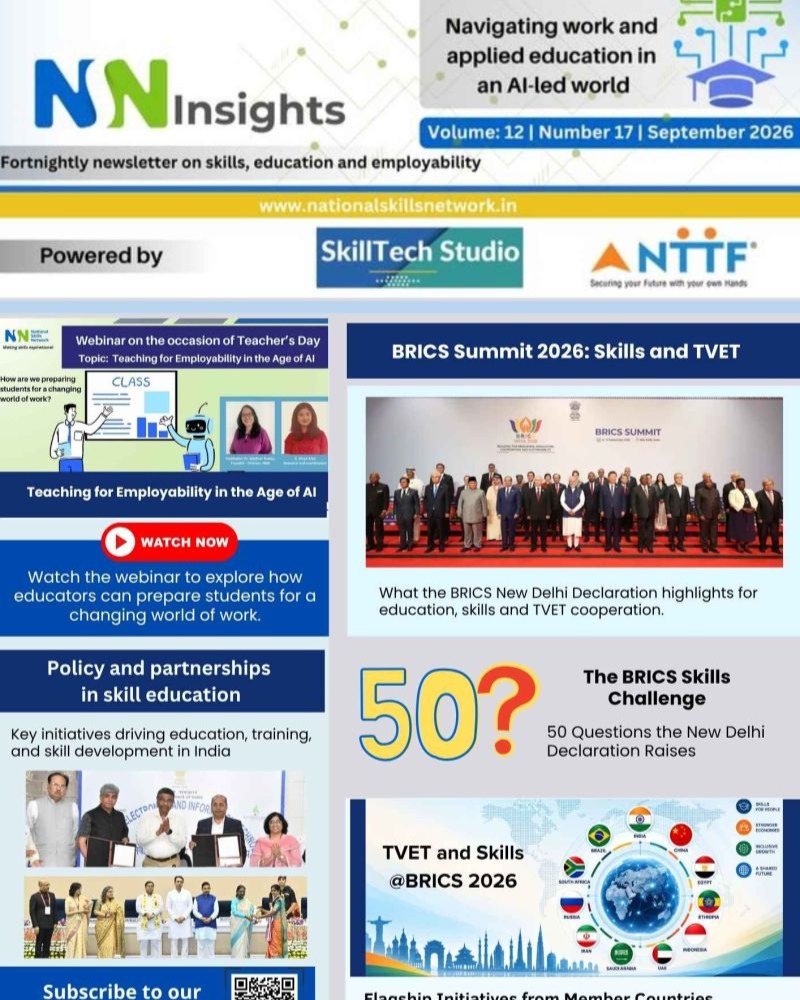
  • From AI in school education to evolving careers in the insurance sector, the focus on skills is becoming more defined across stages of learning and work.In the latest edition, we bring together key themes:• AI and computational thinking are introduced at the school level
• Emerging career opportunities in the insurance industry
• The growing importance of employability skills
• The gap between education and industry expectationsThese shifts highlight a clear direction; skills are central to how education and careers are evolving.Click here to read the latest edition of NSN Insights and explore more - https://sendy.nationalskillsnetwork.in//w/hzLT7swDQzH4qANAeEmr4A#SkillDevelopment #Employability #AIinEducation #Careers #SkillIndia #AI
  • As AI continues to shape how we learn and work, building practical AI skills is becoming increasingly important across sectors.Initiatives like YUVA AI for All under the IndiaAI Mission are helping make AI learning more accessible through structured, short-duration courses, regional language support, and hands-on approaches.From understanding AI fundamentals to learning how to effectively prompt and apply AI tools, the focus is clearly shifting toward real-world usage and human + AI collaboration.Know more: https://nationalskillsnetwork.in/yuva-ai-for-all-explained/#AI #AISkills #IndiaAI #FutureOfWork #SkillDevelopment

About us

National Skills Network (NSN) captures and shares the positive impact of various training, skill development and vocational education initiatives in India.

To know more about Our Team: Click here

Address

NSN Digital Solutions Pvt. Ltd.
CIN: U74999TG2020PTC147299
MSME: UDYAM-TS-09-0086473
Gachibowli, Hyderabad – 500032

Email us: contact@nationalskillsnetwork.com

Important Links

  • Conversations
  • Perspectives
  • News
  • Skill Development e-Magazine
  • Resources
  • Our Team
  • Our Clients
  • Partner with us
  • About us
  • Advertise with us
  • Content Disclaimer
  • Privacy Policy

© 2026 National Skills Network Content licensed under CC BY-ND 4.0. Commercial use requires permission.

loader
No Result
View All Result
  • Home
  • Conversations
    • Industry Conversations
    • All Conversations
  • Perspectives
    • Education
    • Emerging Technologies
    • Government Initiatives
    • Industry
    • Industrial Training Institutes (ITIs)
    • NEP 2020
    • Skill Training
  • News
    • Latest Updates
    • News Archives
    • CSR and ESG in Skill Education
    • Skill Development e-Magazine
    • NSN PDF Newsletter Archives
  • Videos
    • Explainers
    • Panel Discussions
    • Student Stories
    • Video Conversations
  • Resources
    • Apprenticeship
    • e-Books
    • Resources
    • Success Stories
  • Events
    • Workshops
  • About us
    • Our Team
    • Our Clients
    • Our Services
    • Privacy Policy

© 2026 National Skills Network Content licensed under CC BY-ND 4.0. Commercial use requires permission.