NSN
slider image
  • Home
  • Conversations
    • Industry Conversations
    • All Conversations
  • Perspectives
    • Education
    • Emerging Technologies
    • Government Initiatives
    • Industry
    • Industrial Training Institutes (ITIs)
    • NEP 2020
    • Skill Training
  • News
    • Latest Updates
    • News Archives
    • CSR and ESG in Skill Education
    • Skill Development e-Magazine
    • NSN PDF Newsletter Archives
  • Videos
    • Explainers
    • Panel Discussions
    • Student Stories
    • Video Conversations
  • Resources
    • Apprenticeship
    • e-Books
    • Resources
    • Success Stories
  • Events
    • Workshops
  • About us
    • Our Team
    • Our Clients
    • Our Services
    • Privacy Policy
No Result
View All Result
NSN
  • Home
  • Conversations
    • Industry Conversations
    • All Conversations
  • Perspectives
    • Education
    • Emerging Technologies
    • Government Initiatives
    • Industry
    • Industrial Training Institutes (ITIs)
    • NEP 2020
    • Skill Training
  • News
    • Latest Updates
    • News Archives
    • Skill Development e-Magazine
    • NSN PDF Newsletter Archives
  • Resources
    • Apprenticeship
    • E-books
    • Resources
    • Success Stories
  • Events
    • Workshops
  • About us
    • Our Team
    • Our Clients
    • Our Services
    • Privacy Policy
NSN
No Result
View All Result
Home Perspectives Education

The National Credit Framework (NCrF): A potential game-changer for India’s Education System

Guest Author by Guest Author
May 22, 2023
Reading Time: 6 mins read
A A
1

The National Credit Framework (NCrF), a ground-breaking policy reform introduced under the new National Education Policy (NEP 2020), is poised to revolutionise the Indian education system. This policy has the potential to tackle the Achilles heel of Indian education: bridging the gap between education and employment. By doing so, the NCrF seeks to empower a generation of skilled and adaptable learners prepared to confront the challenges of a rapidly evolving global economy.

Author : Mr. Pravesh Dudani, Founder and Chancellor, Medhavi Skills University

India, while being one of the world’s youngest nations, grapples with a perplexing paradox. Despite a substantial demographic dividend, with over 62% of our population in the working-age group (15 – 59 years) and more than 54% under the age of 25, there’s an alarming shortage of necessary skills among our youth. A sobering fact revealed by a 2019 UNICEF assessment forecasts that by 2030, nearly half of Indian adolescents will lack the requisite education and skills for productive employment. This gap threatens not only our progress but also our economic growth, highlighting the urgent need for effective skill development concurrent with quality education.

The NEP 2020 identified this critical gap, underscoring the need to embed skill development within course curricula. To this end, the Government introduced the NCrF, a unified framework to harmonise general and vocational education and ensure seamless mobility between the two. This transformative policy measure was made possible by the combined efforts of UGC, NCVET, AICTE, CBSE, NCERT, NIOS, the Ministry of Education, and the Ministry of Skill Development and Entrepreneurship under the esteemed leadership of Dr. N.S Kalsi (IAS Retd), Chairman of NCVET.

The NCrF has been designed as an overarching framework with a single unified credit level that applies to all the frameworks, such as National School Education Qualification Framework (NSEQF), the National Higher Education Qualification Framework (NHEQF), and the National Skills Qualification Framework (NSQF). 

In this innovative system, any form of learning, including reskilling and upskilling, can earn academic credits once assessed and certified by a government-authorised body, such as recognised Awarding Bodies under NCVET. Credits may be earned from various skilling courses, EdTech platforms, professional training, or even work experience, fostering an aspirational, flexible, affordable and industry-relevant educational landscape.

This new framework echoes the ancient Indian Gurukul system, which incorporated skill development as an integral component of holistic learning. It encourages a multidisciplinary and comprehensive approach to education, allowing students to choose their courses as per their interests and abilities as well as learn at their own pace.

NCrF proposes key shifts in higher education

  • It allows for innovative subject combinations and flexible course completion schedules. Majors and minors can throw up interesting combinations, from Microbiology to Music, thereby fostering a multidisciplinary and holistic education. 
  • Given the equivalence of Skills and Vocational Education with Higher Education, the Higher Education Institutions (HEIs) would be able to integrate standardised competency benchmarked courses as credit-based modules into their programme curriculums. 
  • For example, UGC, as part of the NEP 2020 mandate, has recently mandated all Higher Education Institutions to have about 10 to 40 per cent of the 3- or 4-year undergraduate curriculum as competency-benchmarked skilling courses. This will compel many traditional higher education institutions to reconsider their curriculum and make it more outcome-centric and industry-relevant. 

National Credit Framework (NCrF)

 How NCrF helps students with choice and credits

  • Students are now free to choose what they want to learn, regardless of their institution or mode of learning. Students can accumulate credits from various sources, focusing on skills relevant to new-age job roles, for example, opting for credit-based online courses from MOOCs such as SWAYAM or NPTEL or subscribing to Skill certification courses conducted by National Skill Development Corporation (NSDC) or a Skills University. 
  • They can also acquire credits through projects, internships, formal apprenticeships or any form of on-the-job training. Such outcome-focused learning would encourage students to complete higher education who prefer the learning-by-doing approach and make education inclusive and affordable through the ‘Learn and Earn’ approach. 
  • The accumulated credits will be stored in the ‘Academic Bank of Credits’ (ABC) a unified Aadhar and Digi Locker linked portal maintained by the Government of India through which seamless Assignment / Accumulation / Redemption / Transfers of credits would be possible encompassing School Education / Higher Education / Vocational Education and Skills Training ecosystem.

How NCrF helps the industry in building a talent pool

  • The National Credit Framework (NCrF) opens up a promising avenue for the industry in talent acquisition and retention. It potentially allows Higher Educational Institutes to strategically collaborate with Industries to offer On-the-Job (OJT) embedded Degree / Diploma / Certificate programs. This alignment of educational curriculum with industry needs contributes to the practical skills training of course curriculums, ensuring the development of a talent pool that is better suited to the demands of the market. Moreover, this approach offers a dual advantage – students gain practical experience, equipping them with the necessary skills to become industry-ready, while organisations benefit from a readily available supply of trained personnel, leading to lower training costs, higher productivity and reduced attrition. Such Industry led educational models can potentially improve the affordability of higher education, enhance the Gross Enrolment Ratio (GER) in higher education, and contribute significantly towards the mandate of NEP 2020.
  • The ‘Recognition of Prior Learning’ (RPL) provision of the NCrF is another powerful tool for empowering working professionals. This policy gives professionals a chance to have their expertise and skills, gained through years of experience, formally recognised and accredited. This is a boon to many in the Indian workforce who have gained expertise informally but lack the official academic credentials to back it up.

Moreover, the NCrF paves the way for a culture of lifelong learning. It extends beyond the traditional realms of academic subjects, recognising and rewarding excellence in non-academic skills like sports, music, art and crafts, and world skills competitions. This opens up avenues for students to explore their interests and talents outside the confines of regular academic disciplines, making education a more inclusive and enriching experience.

The introduction of the NCrF under the aegis of NEP 2020 is a historic moment for the Indian education ecosystem. It signals a decisive move by the Central Government under the visionary leadership of our Prime Minister of India, Shri Narendra Modi, towards bridging the gap between education and employment – a shift that could redefine the future of millions of Indian youth. By mainstreaming skill development and experiential learning, the NCrF aims to utilise India’s demographic dividend optimally and propel social progress.

To conclude, the NCrF embodies the transformative vision of the National Education Policy 2020, promising to re-engineer the landscape of education in India. As we move forward, it will be critical to ensure its effective implementation across the length and breadth of the country, involving all stakeholders—students, industries, educational institutions, and the state governments—in the process. 

It might also interest you to read: Medhavi Skills University – Empowering youth through skill-based higher education

With this collaborative effort, we can hope to witness the NCrF becoming the cornerstone of a new, vibrant, and progressive educational system in India, one that nurtures a generation of empowered youth equipped with a holistic education and industry-relevant skills. I believe that NCrF, as part of the new NEP 2020, will go down in the pages of history as one of the most significant policy reforms in India, a true game-changer in our education system.

RelatedPosts

NCVET: Recognition and Accreditation in India’s Skill Ecosystem

7 Practical Ways to Improve Graduate Employability in India

Applied Learning for Skill Education in Schools: A Perspective from Victoria, Australia

Tags: Higher education in IndiaIndian education systemNational Credit Framework (NCrF)National Education Policy (NEP) 2020National School Education Qualification Framework (NSEQF)Recognition of Prior Learning-RPLskill development and experiential learning
ShareTweetShareSummarizeSummarize
WhatsApp Join our WhatsApp channel for more updates:
WhatsApp Join Now!
YouTube Subscribe to our YouTube channel for more updates:
YouTube Subscribe Now!
Previous Post

Future Right Skills Network (FRSN): Preparing ITIs for Future of Work

Next Post

NSN Weekly newsbytes on skills, education and training-23052023

Guest Author

Guest Author

Next Post
NSN Weekly newsbytes on skills, education and training-23052023

NSN Weekly newsbytes on skills, education and training-23052023

Comments 1

  1. Nervecalm says:
    3 weeks ago

    This blog post does a fantastic job of breaking down the National Credit Framework and its potential impact on India’s education system. I appreciate how it highlights the flexibility and skill-based approach that could better prepare students for the job market. I’m curious to see how this will be implemented across various institutions and how it will affect traditional learning methods. Thanks for the insights!

    Reply

Leave a Reply Cancel reply

Your email address will not be published. Required fields are marked *

No Result
View All Result
samplead3 samplead1

Subscribe to our e-Magazine

Trending Topics

skilling in India (131) National Skill Development Corporation - NSDC (127) skill development news India (125) skill development (118) Ministry of Skill Development and Entrepreneurship MSDE (102) vocational education (97) Apprenticeships (91) skill development news (81) NEP 2020 (74) skill development programs (71)

Follow us

  • Why practical training is essential for building a productive, job-ready workforceIn today’s fast-evolving job market, industries expect employees to be productive from day one. But productivity does not come from theory alone. It comes from doing.Practical training bridges the gap between knowledge and real-world application. It builds confidence, competence, and consistency, the core traits of a job-ready workforce.So, from emerging sectors like EVs and solar to healthcare and logistics, hands-on learning ensures individuals can adapt to tools, technologies, and real workplace challenges.If we want a workforce that delivers results, we need to prioritise practical, industry-aligned training.Click here to read more: https://nationalskillsnetwork.in/why-practical-training-is-essential-for-building-a-productive-job-ready-workforce/#skilldevelopment #practicallearning #vocationaltraining #employability
  • National Skills Network-NSN celebrates 11 years!!We are grateful for your continued support and engagement over the years. It has been central to this journey. This milestone reflects both our journey and the ecosystem we’ve engaged with.Over the last decade, we’ve observed and gained a clear perspective on how education, skills, and careers are evolving across the ecosystem.And one insight continues to stand out.The gap is no longer about skills awareness.The gap is in the transition from education to employability.To strengthen a complex, fragmented, but evolving ecosystem, a shift is needed.Many pathways are still shaped by compromise, confusion, or circumstance, making the system largely reactive.From reactive responses
- to proactive pathwaysWhere:
💠Skills are integrated into education early
💠Learning is connected to real-world application
💠Employability is built into the systemAs NSN marks 11 years, we remain focused on contributing to this shift through deeper engagement, conversations, and collaborations across the ecosystem.If this resonates with your work, let us know how you would like to engage with NSN. Scan the code to connect!#NSN11Years #workanniversary #skilldevelopment #employability #education
  • Why do skills matter more than degrees in the gig economy?As the gig economy continues to grow, online freelancing and platform-based work are becoming important career pathways for young people. However, most education and training systems are still focused on traditional job models, creating a gap between learning and real-world work.In this conversation, Dr. Madhuri Dubey, Ph.D, Founder Director, National Skills Network-NSN, speaks with Ms. Pooja Gianchandani, Global Lead – Skills for Gig Economy at GIZ Germany, to discuss:What gig work really includes:💠The difference between location-based work and online freelancing
💠Why learners are not fully prepared for gig and platform work
💠Key challenges in freelancing and digital work
💠How the Online Freelancer Training (OFT) Toolkit helps bridge this gap
💠The importance of technical, transversal, and transitional skills
💠Why a mindset shift is critical for the future of workWatch the full conversation to understand how skills training needs to evolve for the gig economy - https://youtu.be/9TQjkLPSolo?si=MuUH4pmDiQBPPd8b#gigeconomy #gigwork #platformwork #onlinefreelancing #toolkit #GIZ
  • From internships and sector-specific skills to training infrastructure and policy frameworks, multiple developments are shaping how skills are built and delivered.In the latest edition of NSN Insight, explore:• Key updates on the PM Internship Scheme 2026
• Skill requirements and emerging roles in the Textile and BFSI sectors
• The role and impact of Sector Skill Councils
• ROI of modern training tools and setting up skill training centres
• NCVET’s role in recognition, accreditation, and evolving frameworks
• A quick quiz to test your understanding of Sector Skill CouncilsClick here to read the latest edition of NSN Insights and explore more - https://sendy.nationalskillsnetwork.in//w/g7gCNS8rXg892X65Z5tjz2iA#skilldevelopment #BFSI #textileindustry #internships #training #NCVET
  • 7 Practical Ways to Improve Graduate Employability in IndiaGraduate employability continues to be a critical challenge, with a clear gap between education and industry expectations. It’s not just about skills anymore; it’s about readiness, exposure, and the ability to apply learning in real-world contexts.In our latest article, we explore 7 practical ways to improve graduate employability in India, to help individuals and institutions take actionable steps.Read more: https://nationalskillsnetwork.in/graduate-employability-india-7-ways/#graduateemployability #skilldevelopment #highereducation #employability
  • Applications for the Prime Minister Internship Scheme 2026 are now open, offering paid internship opportunities with a ₹9,000 monthly stipend and hands-on experience with leading companies.With updated guidelines, flexible duration, and a focus on real workplace exposure, the scheme aims to strengthen employability and provide a clear pathway from education to industry.Learn more about the eligibility, key updates, benefits, and how to apply.Click here to read more: https://nationalskillsnetwork.in/pm-internship-scheme-2026-updates/#PMInternshipScheme #PMIS2026 #Internships #SkillDevelopment #Employability
  • India’s digital journey is entering a new phase where artificial intelligence is becoming part of everyday learning, work, and decision-making. The YUVA AI for All course, introduced under the IndiaAI Mission, is designed to make AI learning simple, practical, and accessible to learners from all backgrounds.This structured course helps individuals understand AI fundamentals, explore real-world applications, and build the confidence to work with AI tools effectively, ensuring that AI is not limited to experts but becomes a skill for everyone.#Yuvaai #artificialintelligence #aiskills #aitools
  • Financial Skills and Education for School and College StudentsFinancial literacy is increasingly being recognised as a core life skill for students. As young people navigate digital transactions, changing career pathways, and financial responsibilities, early exposure to money management and financial concepts becomes essential.In this article, explore how financial education can move beyond basic awareness to build practical understanding. From covering decision-making, risk, markets, and long-term financial thinking.It also highlights the role of schools and colleges in preparing students to engage confidently with real-world financial situations.Read more: https://nationalskillsnetwork.in/financial-skills-education-for-students/#financialliteracy #financialeducation #schooleducation #highereducation #finance
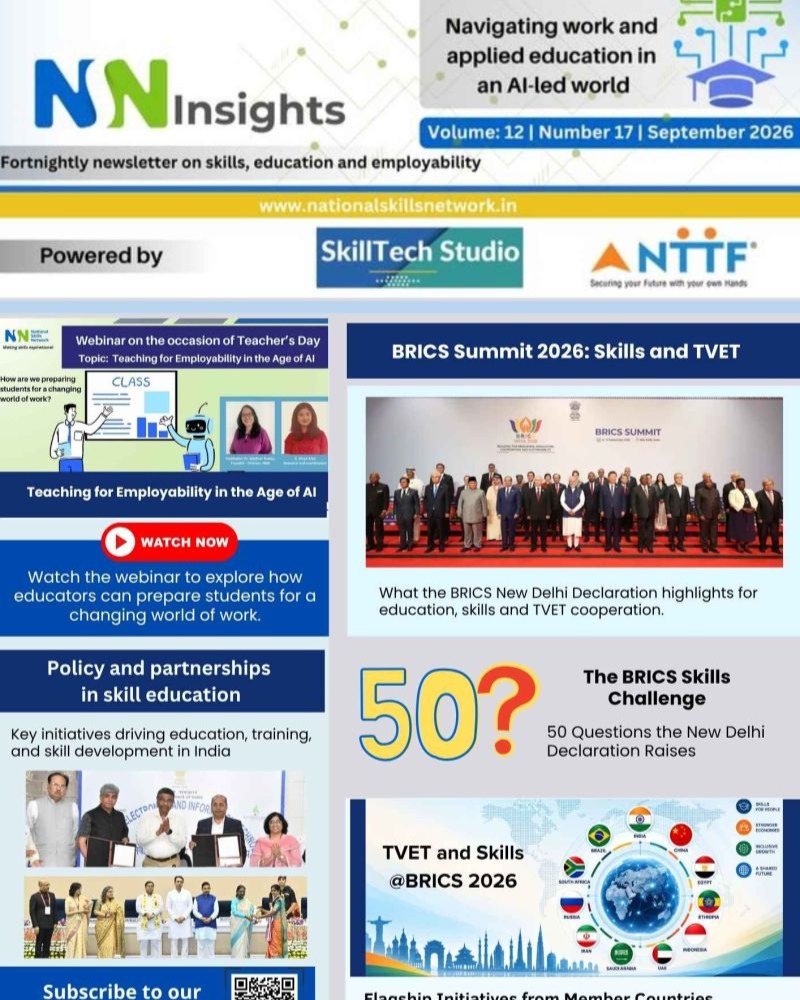
  • From AI in school education to evolving careers in the insurance sector, the focus on skills is becoming more defined across stages of learning and work.In the latest edition, we bring together key themes:• AI and computational thinking are introduced at the school level
• Emerging career opportunities in the insurance industry
• The growing importance of employability skills
• The gap between education and industry expectationsThese shifts highlight a clear direction; skills are central to how education and careers are evolving.Click here to read the latest edition of NSN Insights and explore more - https://sendy.nationalskillsnetwork.in//w/hzLT7swDQzH4qANAeEmr4A#SkillDevelopment #Employability #AIinEducation #Careers #SkillIndia #AI

About us

National Skills Network (NSN) captures and shares the positive impact of various training, skill development and vocational education initiatives in India.

To know more about Our Team: Click here

Address

NSN Digital Solutions Pvt. Ltd.
CIN: U74999TG2020PTC147299
MSME: UDYAM-TS-09-0086473
Gachibowli, Hyderabad – 500032

Email us: contact@nationalskillsnetwork.com

Important Links

  • Conversations
  • Perspectives
  • News
  • Skill Development e-Magazine
  • Resources
  • Our Team
  • Our Clients
  • Partner with us
  • About us
  • Advertise with us
  • Content Disclaimer
  • Privacy Policy

© 2026 National Skills Network Content licensed under CC BY-ND 4.0. Commercial use requires permission.

loader
No Result
View All Result
  • Home
  • Conversations
    • Industry Conversations
    • All Conversations
  • Perspectives
    • Education
    • Emerging Technologies
    • Government Initiatives
    • Industry
    • Industrial Training Institutes (ITIs)
    • NEP 2020
    • Skill Training
  • News
    • Latest Updates
    • News Archives
    • CSR and ESG in Skill Education
    • Skill Development e-Magazine
    • NSN PDF Newsletter Archives
  • Videos
    • Explainers
    • Panel Discussions
    • Student Stories
    • Video Conversations
  • Resources
    • Apprenticeship
    • e-Books
    • Resources
    • Success Stories
  • Events
    • Workshops
  • About us
    • Our Team
    • Our Clients
    • Our Services
    • Privacy Policy

© 2026 National Skills Network Content licensed under CC BY-ND 4.0. Commercial use requires permission.