NSN
slider image
  • Home
  • Conversations
    • Industry Conversations
    • All Conversations
  • Perspectives
    • Education
    • Emerging Technologies
    • Government Initiatives
    • Industry
    • Industrial Training Institutes (ITIs)
    • NEP 2020
    • Skill Training
  • News
    • Latest Updates
    • News Archives
    • CSR and ESG in Skill Education
    • Skill Development e-Magazine
    • NSN PDF Newsletter Archives
  • Videos
    • Explainers
    • Panel Discussions
    • Student Stories
    • Video Conversations
  • Resources
    • Apprenticeship
    • e-Books
    • Resources
    • Success Stories
  • Events
    • Workshops
  • About us
    • Our Team
    • Our Clients
    • Our Services
    • Privacy Policy
No Result
View All Result
NSN
  • Home
  • Conversations
    • Industry Conversations
    • All Conversations
  • Perspectives
    • Education
    • Emerging Technologies
    • Government Initiatives
    • Industry
    • Industrial Training Institutes (ITIs)
    • NEP 2020
    • Skill Training
  • News
    • Latest Updates
    • News Archives
    • Skill Development e-Magazine
    • NSN PDF Newsletter Archives
  • Resources
    • Apprenticeship
    • E-books
    • Resources
    • Success Stories
  • Events
    • Workshops
  • About us
    • Our Team
    • Our Clients
    • Our Services
    • Privacy Policy
NSN
No Result
View All Result
Home Perspectives Government

Dr Mahendra Nath Pandey, highlights leather sector’s potential to create jobs at the RPL Certification ceremony

Team NSN by Team NSN
September 22, 2019
Reading Time: 4 mins read
A A
2

Dr. Mahendra Nath Pandey, Hon’ble Minister for Skill Development and Entrepreneurship (MSDE), Govt. of India highlighted that the Leather sector is an export driven sector and has the potential to create 2 million jobs in the next 5 years. The Government of India had recently announced in the Budget of 2019 that export duty be rationalized on raw and semi-finished leather increasing opportunities in the sector. He was speaking at a ceremony where more than a thousand candidates in the leather sector were awarded Recognition of Prior Learning (RPL) Certificates in Chennai,

Minister, Skill Development and Entrepreneurship distributes certificates to RPL trainees under Pradhan Mantri Kaushal Vikas Yojana  Leather sector has the potential to create 2 million jobs in the next 5 years – Dr Mahendra Nath Pandey, Union Minister More than 2 million candidates across the country have received RPL certification under the PMKVY Launch of Mochi Swabhimaan Initiative – a nationwide effort in which LSSC will support the cobbler community who provide leather-based services, with CSR funds ensuring they work in a dignified manner

Speaking at a ceremony today where more than a thousand candidates in the leather sector were awarded Recognition of Prior Learning (RPL) Certificates in Chennai, Dr. Mahendra Nath Pandey, Hon’ble Minister for Skill Development and Entrepreneurship (MSDE), Govt. of India said the Leather Sector is an Export driven sector and has the potential to create 2 million jobs in the next 5 years. The Government of India had recently announced in the Budget of 2019 that export duty be rationalized on raw and semi-finished leather increasing opportunities in the sector.

Dr. Pandey distributed Recognition of Prior Learning (RPL) certificates to the graduating trainees under Pradhan Mantri Kaushal Vikas Yojana (PMKVY) of Skill India, who were trained, assessed and certified on their existing skill sets across leather companies with the due effort of the Leather Sector Skill Council (LSSC). The certification ceremony was graced by Shri K Pandiarajan, Minister for Tamil language, Tamil Culture and Archeology.

Ministry of Skill Development and Entrepreneurship works closely with the LSSC under Pradhan Mantri Kaushal Vikas Yojana (PMKVY) which encourages skill development to boost employability and productivity of youth by incentivizing skill training. Recognition of Prior Learning (RPL), under PMKVY, certifies skills acquired informally and drives youth to venture into aspirational job roles. For the industry, formalizing the skills of employees will give a clear picture about the available skill sets, skill gaps and the need for upgradation to achieve desirable quality and productivity benchmarks. The outstanding candidates, certified under RPL, were given Best in Class Employer Scheme and HRD Scheme certificates during the ceremony.

Related article: Recognition of Prior Learning – RPL – Read more: https://nationalskillsnetwork.in/recognition-of-prior-learning-rpl/

Dr Mahendra Nath Pandey, highlights leather sector's potential to create jobs at the RPL Certification ceremonyAs of last week, more than 2 million candidates across the country have received RPL under the PMKVY (2016-20). As per the latest report (17 September 2019), of the 2.78 million candidates enrolled, 2.70 million have been trained while 2.15 million have been assessed and 2.03 million have been given certificates.

Lauding the efforts of LSSC, Dr. Mahendra Nath Pandey, Hon’ble Minister for Skill Development and Entrepreneurship stated, “Globally, India is the second largest producer of leather garments and footwear and with this phenomenal market potential, the sector seems promising in the years to come. When we look back at our past, India has always had a rich heritage of leather crafts like footwear and accessories. These were prepared by highly skilled craftsmen from various clusters like Agra, Kanpur, Ambur and other regions. Today, these skills need to be preserved and people should be encouraged to make them a means of sustainable livelihood. I am glad to see the outcome of your RPL programs undertaken in close collaboration with the industry. I congratulate all the candidates who are receiving their certificates today and wish them better opportunities for continued learning and career development. I wish you all great success and I extend continued support to LSSC team and all their partners.”

“The Government of India has allowed 100% foreign direct investment (FDI) in the sector and rationalized export duty on raw and semi-finished leather. The sector employees over 2.5 million people and has potential to create 2 million jobs in the next 5 years,” he further added.

India accounts for about 13% of the world’s leather production. Footwear and Leather products in the world. The leather and leather products industry contribute less than 1% to India’s GDP and Footwear industry contributes about 2% to India’s GDP. Indian leather industry has huge potential for exports. It can reach USD 9.0 billion by 2020, from the present level of USD 5.85 billion. India has trade agreements with Japan, Korea, ASEAN, Chile etc., and is negotiating Free Trade Agreement (FTA) with European Union, Australia etc.

Launch of Mochi Swabhimaan Initiative

“Fashion and trends have a great influence in this industry. There are many opportunities for entrepreneurship in traditional leather trades and new forms of leather substitutes. We need to cater to basic needs as well as luxury segments, with vast potential for exports. On this occasion, I would advise the Small and Medium Enterprises (SMEs) and Micro, Small and Medium Enterprises (MSMEs) to review their manufacturing processes in terms of quality of output and wastage reduction by skilled professionals. I am also happy to announce the “Mochi Swabhimaan Initiative, a nation-wide activity where LSSC will extend support to the cobbler community who provide leather-based services, with CSR funds and bring respect to their skills by giving them better working environment in the form of kiosks/umbrellas . The government will also support this idea and will ensure they work in a dignified manner,” said Dr. Pandey.

RelatedPosts

National Qualifications Register (NQR) – A unified platform for skill-based qualifications

PMKVY 4.0 explained! All you need to know about India’s flagship skill scheme

National Council for Vocational Education and Training (NCVET) – An Overview

“Technology has had a huge impact on every industry and leather is not left behind. While your manufacturing set up and factory premises need quick upgrades you should also focus on today’s e-commerce scenario. This brings in the need for multiskilling the workforce in the leather industry, since they will need appropriate digital skills to interact with online systems and a global customer base. I hope you are already taking these steps in this direction to expand your global outreach,” said the Minister.

To recognize and enhance the value of skilled manpower, LSSC has successfully implemented the RPL program to certify the workforce as per the National Skills Qualifications Framework (NSQF). The certification will contribute to the mobility of the workforce and will reduce employer dependence for recognition. Particularly, for the women who form a large chunk of the workforce, RPL will encourage them to enhance their skills basis their certification levels.

Tags: FDI in Leather industryLeather MSME and skillingLeather sector job creationP R Aqeel Ahmed Chairman LSSCPMKVY RPL Leather certificationRecognition of Prior Learning-RPL
ShareTweetShareSummarizeSummarize
WhatsApp Join our WhatsApp channel for more updates:
WhatsApp Join Now!
YouTube Subscribe to our YouTube channel for more updates:
YouTube Subscribe Now!
Previous Post

Electronics Sector Skills Council of India conducts ESSCI Utsav 2019 to mark its 7th anniversary

Next Post

News Bytes from NSN – Quick updates on Skill Development and Vocational Training – 230919

Team NSN

Team NSN

Next Post
News Bytes on Skill Development and Vocational Training – 230919

News Bytes from NSN – Quick updates on Skill Development and Vocational Training – 230919

Leave a Reply Cancel reply

Your email address will not be published. Required fields are marked *

No Result
View All Result
samplead3 samplead1

Subscribe to our e-Magazine

Trending Topics

skilling in India (131) National Skill Development Corporation - NSDC (127) skill development news India (125) skill development (117) Ministry of Skill Development and Entrepreneurship MSDE (102) vocational education (97) Apprenticeships (90) skill development news (81) NEP 2020 (73) skill development programs (71)

Follow us

  • 7 Practical Ways to Improve Graduate Employability in IndiaGraduate employability continues to be a critical challenge, with a clear gap between education and industry expectations. It’s not just about skills anymore; it’s about readiness, exposure, and the ability to apply learning in real-world contexts.In our latest article, we explore 7 practical ways to improve graduate employability in India, to help individuals and institutions take actionable steps.Read more: https://nationalskillsnetwork.in/graduate-employability-india-7-ways/#graduateemployability #skilldevelopment #highereducation #employability
  • Applications for the Prime Minister Internship Scheme 2026 are now open, offering paid internship opportunities with a ₹9,000 monthly stipend and hands-on experience with leading companies.With updated guidelines, flexible duration, and a focus on real workplace exposure, the scheme aims to strengthen employability and provide a clear pathway from education to industry.Learn more about the eligibility, key updates, benefits, and how to apply.Click here to read more: https://nationalskillsnetwork.in/pm-internship-scheme-2026-updates/#PMInternshipScheme #PMIS2026 #Internships #SkillDevelopment #Employability
  • India’s digital journey is entering a new phase where artificial intelligence is becoming part of everyday learning, work, and decision-making. The YUVA AI for All course, introduced under the IndiaAI Mission, is designed to make AI learning simple, practical, and accessible to learners from all backgrounds.This structured course helps individuals understand AI fundamentals, explore real-world applications, and build the confidence to work with AI tools effectively, ensuring that AI is not limited to experts but becomes a skill for everyone.#Yuvaai #artificialintelligence #aiskills #aitools
  • Financial Skills and Education for School and College StudentsFinancial literacy is increasingly being recognised as a core life skill for students. As young people navigate digital transactions, changing career pathways, and financial responsibilities, early exposure to money management and financial concepts becomes essential.In this article, explore how financial education can move beyond basic awareness to build practical understanding. From covering decision-making, risk, markets, and long-term financial thinking.It also highlights the role of schools and colleges in preparing students to engage confidently with real-world financial situations.Read more: https://nationalskillsnetwork.in/financial-skills-education-for-students/#financialliteracy #financialeducation #schooleducation #highereducation #finance
  • From AI in school education to evolving careers in the insurance sector, the focus on skills is becoming more defined across stages of learning and work.In the latest edition, we bring together key themes:• AI and computational thinking are introduced at the school level
• Emerging career opportunities in the insurance industry
• The growing importance of employability skills
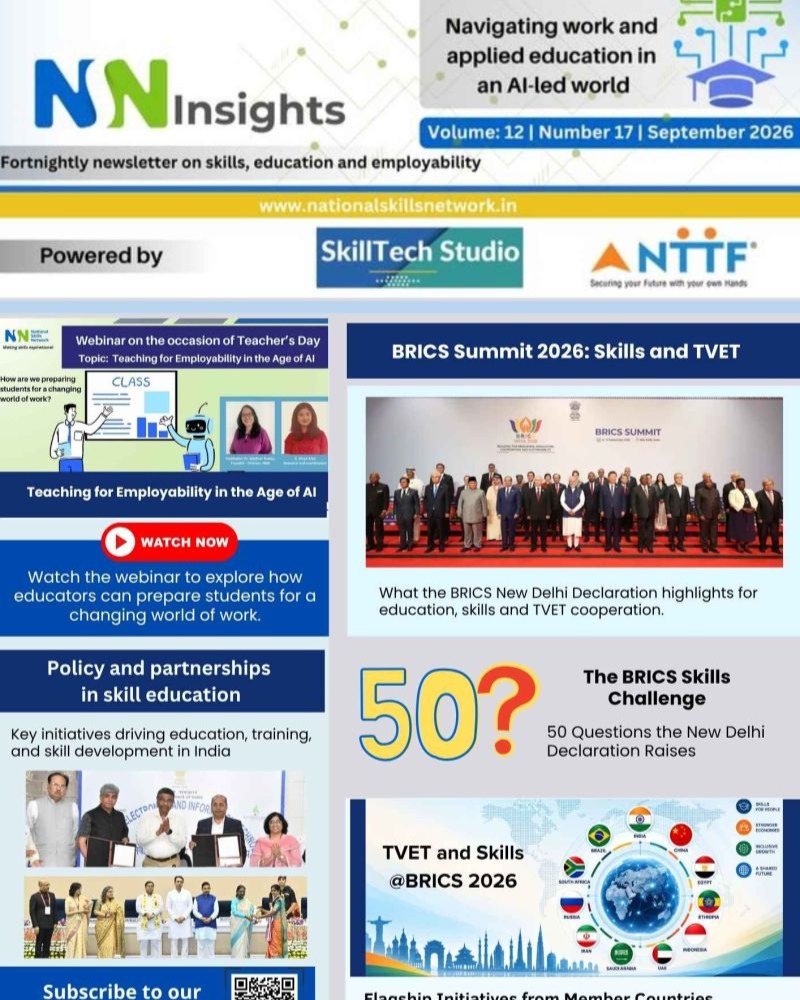
• The gap between education and industry expectationsThese shifts highlight a clear direction; skills are central to how education and careers are evolving.Click here to read the latest edition of NSN Insights and explore more - https://sendy.nationalskillsnetwork.in//w/hzLT7swDQzH4qANAeEmr4A#SkillDevelopment #Employability #AIinEducation #Careers #SkillIndia #AI
  • As AI continues to shape how we learn and work, building practical AI skills is becoming increasingly important across sectors.Initiatives like YUVA AI for All under the IndiaAI Mission are helping make AI learning more accessible through structured, short-duration courses, regional language support, and hands-on approaches.From understanding AI fundamentals to learning how to effectively prompt and apply AI tools, the focus is clearly shifting toward real-world usage and human + AI collaboration.Know more: https://nationalskillsnetwork.in/yuva-ai-for-all-explained/#AI #AISkills #IndiaAI #FutureOfWork #SkillDevelopment
  • Key developments this week highlight how India’s skilling ecosystem is advancing through policy reforms, industry collaboration and emerging technologies.From the launch of the Skills Outcomes Fund and record growth in apprenticeships to new AI programmes, scholarships and sector-specific training initiatives, the focus continues to be on building a future-ready workforce.Efforts across healthcare, manufacturing and creative industries are further strengthening pathways to employment.Explore the key highlights in this week’s NSN Newsbytes: https://nationalskillsnetwork.in/newsbytes-skill-education-14-april-2026/#SkillDevelopment #CSR #Apprenticeships #AI #VocationalEducation
  • COL-CEMCA Conducts Three-Day Workshop on Graduate Employability at YCMOU, Nashik, MaharashtraDr. Madhuri Dubey, Founder-Director, NSN, facilitated the workshop as a part of the Commonwealth of Learning - Commonwealth Educational Media Centre for Asia (CoL-CEMCA) Project on enhancing graduate employability by integrating appropriate skills into the curriculum.The workshop was organized by CoL-CEMCA in collaboration with Yashwantrao Chavan Maharashtra Open University (YCMOU), Nashik, from 10th to 12th March, 2026, at the YCMOU campus in Nashik, Maharashtra under the guidance of Dr. B. Shadrach, Director, CEMCA and Dr Jane Agbu , Adviser Higher Education, Commonwealth of Learning.
The workshop was inaugurated by Prof. Sanjeev Sonawane, honourable Vice-Chancellor, YCMOU, and coordinated by Dr. Amol Shirfule, Director i/c, Yash Center for Innovation, Incubation and Linkages and Dr. Nagarjun Wadekar, Director, School of Social Sciences and Humanities, YCMOU.As a part of the comprehensive Graduate Employability Project, the workshop brought together academic leaders representing different schools of specialization, course coordinators, and faculty members from YCMOU to strengthen curriculum design with a focus on employability skills and industry relevance.The workshop emphasised the transition from traditional content-driven teaching to outcome-based education using the Results-Based Management (RBM) Framework. Participants engaged in discussions and practical exercises to align learning outcomes with professional competencies and labour market needs.#employability #openuniversity #graduates #skills #education
  • The conversation around skills and education in India continues to evolve, with a growing focus on employability, industry relevance, and future-ready careers.From applied learning in schools to emerging opportunities in sectors like electric vehicles and the increasing importance of transferable skills, the shift is clearly towards building a more adaptable and skilled workforce.In the latest edition, we also cover key developments across policy, industry collaborations, and skilling initiatives shaping the ecosystem.Explore the latest edition of NSN Insights to know more - https://sendy.nationalskillsnetwork.in//w/QSEDv2CnW892B3SndfpAHoXw#skilldevelopment #employabilityskills #appliedlearning #EVjobs #NEP2020

About us

National Skills Network (NSN) captures and shares the positive impact of various training, skill development and vocational education initiatives in India.

To know more about Our Team: Click here

Address

NSN Digital Solutions Pvt. Ltd.
CIN: U74999TG2020PTC147299
MSME: UDYAM-TS-09-0086473
Gachibowli, Hyderabad – 500032

Email us: contact@nationalskillsnetwork.com

Important Links

  • Conversations
  • Perspectives
  • News
  • Skill Development e-Magazine
  • Resources
  • Our Team
  • Our Clients
  • Partner with us
  • About us
  • Advertise with us
  • Content Disclaimer
  • Privacy Policy

© 2026 National Skills Network Content licensed under CC BY-ND 4.0. Commercial use requires permission.

loader
No Result
View All Result
  • Home
  • Conversations
    • Industry Conversations
    • All Conversations
  • Perspectives
    • Education
    • Emerging Technologies
    • Government Initiatives
    • Industry
    • Industrial Training Institutes (ITIs)
    • NEP 2020
    • Skill Training
  • News
    • Latest Updates
    • News Archives
    • CSR and ESG in Skill Education
    • Skill Development e-Magazine
    • NSN PDF Newsletter Archives
  • Videos
    • Explainers
    • Panel Discussions
    • Student Stories
    • Video Conversations
  • Resources
    • Apprenticeship
    • e-Books
    • Resources
    • Success Stories
  • Events
    • Workshops
  • About us
    • Our Team
    • Our Clients
    • Our Services
    • Privacy Policy

© 2026 National Skills Network Content licensed under CC BY-ND 4.0. Commercial use requires permission.