NSN
slider image
  • Home
  • Conversations
    • Industry Conversations
    • All Conversations
  • Perspectives
    • Education
    • Emerging Technologies
    • Government Initiatives
    • Industry
    • Industrial Training Institutes (ITIs)
    • NEP 2020
    • Skill Training
  • News
    • Latest Updates
    • News Archives
    • CSR and ESG in Skill Education
    • Skill Development e-Magazine
    • NSN PDF Newsletter Archives
  • Videos
    • Explainers
    • Panel Discussions
    • Student Stories
    • Video Conversations
  • Resources
    • Apprenticeship
    • e-Books
    • Resources
    • Success Stories
  • Events
    • Workshops
  • About us
    • Our Team
    • Our Clients
    • Our Services
    • Privacy Policy
No Result
View All Result
NSN
  • Home
  • Conversations
    • Industry Conversations
    • All Conversations
  • Perspectives
    • Education
    • Emerging Technologies
    • Government Initiatives
    • Industry
    • Industrial Training Institutes (ITIs)
    • NEP 2020
    • Skill Training
  • News
    • Latest Updates
    • News Archives
    • Skill Development e-Magazine
    • NSN PDF Newsletter Archives
  • Resources
    • Apprenticeship
    • E-books
    • Resources
    • Success Stories
  • Events
    • Workshops
  • About us
    • Our Team
    • Our Clients
    • Our Services
    • Privacy Policy
NSN
No Result
View All Result
Home Perspectives Skill Training

Skilling in the time of Coronavirus

Guest Author by Guest Author
March 30, 2020
Reading Time: 3 mins read
A A
1

The most unprecedented situation arising out of Coronavirus has unwittingly given a boost to online learning through digital media. In this guest article, Meena Raghunathan, Executive Director, Community Services, GMR Varalakshmi Foundation, shares her views on skilling in the time of Coronavirus,

It is well known that crisis is the time of most innovation.

In skilling too, we have to innovate—there is no option. Skill training centres have been closed, all trainings stopped and youth are back in their home – not knowing how to utilize their time and also uncertain about the future.

In this situation, the education system, whether schools, colleges, or tutoring systems, have almost instantly moved to distance learning and e-learning, while the skill environment needs to catch up with this speed. Of course even before the crisis, MSDE and NSDC have taken steps for encouraging the use of IT and other such modes of learning in vocational training. Individual agencies and training partners have also innovated—whether in developing content or in delivery through distance modes. Now is the time for a paradigm shift.

Admittedly it is not easy to do this in the skilling ecosystem. From the fact that our target group often do not have the necessary connectivity or e-learning readiness, to the fact that skilling is a lot about hands-on, there are many barriers at each step—from mobilization, to content development, to delivery, to testing and certification.

But we have to apply ourselves seriously to this question. The post-Corona world will have even more challenges and the nature of jobs and work may change. It is more important than ever for stakeholders in the skilling system to brainstorm, prepare and take action.

Moreover, youth are at home, with time available. It is essential to use this downtime for productive learning. Equally, it is an opportunity for upskilling for every vocation and profession.

Skilling in the time of CoronavirusSome critical points are:

  1. What can we do for skilling when in lockdown or near lockdown conditions? Once we find the solutions, these may then become the order of the day in the post-crisis world. For instance, how can we shift to much more distance learning, e-based individual learning, etc.? The entire skilling ecosystem needs to undergo a paradigm shift. Can we think of blended learning, where learn-from-home is possible for theory aspects, and there are several centres for hands-on training for practical aspects, which are used with caution and under clear guidelines? An entire IT backbone has to be created for running the system. What about content creation, access, testing and certification? NSDC and stakeholders need to work together urgently.
  2. How can we support upskilling and re-skilling in this situation? What systems of RPL can we put into place and how can we encourage and facilitate more and more people to take them up?
  3. In the scenario of job losses, the linkage between skilling and jobs is tenuous. The skilling system for the short term, has to focus on skilling with the intent of preparing people for jobs that may emerge, to the best current understanding, and with the objective of productive use of time.
  4. Communication, English, Soft skills are probably subjects that can be handled more effectively than hard skills through IT interface. Can we focus on that for various sections?

And for some of these, it is not that we have to start from scratch. In terms of e-learning content, NSDC already has a separate site –eskillindia.org where a number of organizations have shared their e-content. Training partners and trainees can evaluate these and put them into use. Many other organizations have e-content like Schoolnet (earlier IL&FS Skills), Labournet, ishiksha of SKillpro to name a few which can be used for such purposes.

Similarly for spoken English and soft skills there are hundreds of modules and videos available for free or for a very less cost which can be subscribed for the trainees during these times.

At GMRVF, we have started with some 100 questions and brief topical notes sent on Whatsapp to trainees. We are also sharing some video resources or links available for different skills with them.

Related article: GMRVF’s impactful initiatives in creating and sustaining gainful employment through education and skill development – Read more: https://nationalskillsnetwork.in/gmr-varalakshmi-foundation/

But it is now the time to go from incremental steps to a paradigm shift; from reactive measures to quickly gauging the situation and taking charge.

All of us are floundering in this unprecedented crisis. But maybe we should strive to flounder with some purpose and direction. Who knows, maybe in this crisis also lie opportunities.

(Thanks to Vidya Chandy of Chiratae Ventures for setting off this train of thought.)

RelatedPosts

Why skills over degrees matter for online freelancing in gig economy

IndiaSkills Competition 2025-26: Pathway to WorldSkills, Shanghai

Transferable Skills: Why they are essential for employability and career growth

Tags: online courses for skillingskill development and online learningSkilling in the time of Coronavirus
ShareTweetShareSummarizeSummarize
WhatsApp Join our WhatsApp channel for more updates:
WhatsApp Join Now!
YouTube Subscribe to our YouTube channel for more updates:
YouTube Subscribe Now!
Previous Post

News Bytes on Skill Development and Vocational Training – 30032020

Next Post

MSDE extends enrollments under PMKVY for North-Eastern Region till 31st May 2020

Guest Author

Guest Author

Next Post
MSDE extends enrollments under PMKVY for North-Eastern Region till 30th May 2020

MSDE extends enrollments under PMKVY for North-Eastern Region till 31st May 2020

Leave a Reply Cancel reply

Your email address will not be published. Required fields are marked *

No Result
View All Result
samplead3 samplead1

Subscribe to our e-Magazine

Trending Topics

skilling in India (131) National Skill Development Corporation - NSDC (127) skill development news India (125) skill development (118) Ministry of Skill Development and Entrepreneurship MSDE (102) vocational education (97) Apprenticeships (90) skill development news (81) NEP 2020 (73) skill development programs (71)

Follow us

  • From internships and sector-specific skills to training infrastructure and policy frameworks, multiple developments are shaping how skills are built and delivered.In the latest edition of NSN Insight, explore:• Key updates on the PM Internship Scheme 2026
• Skill requirements and emerging roles in the Textile and BFSI sectors
• The role and impact of Sector Skill Councils
• ROI of modern training tools and setting up skill training centres
• NCVET’s role in recognition, accreditation, and evolving frameworks
• A quick quiz to test your understanding of Sector Skill CouncilsClick here to read the latest edition of NSN Insights and explore more - https://sendy.nationalskillsnetwork.in//w/g7gCNS8rXg892X65Z5tjz2iA#skilldevelopment #BFSI #textileindustry #internships #training #NCVET
  • 7 Practical Ways to Improve Graduate Employability in IndiaGraduate employability continues to be a critical challenge, with a clear gap between education and industry expectations. It’s not just about skills anymore; it’s about readiness, exposure, and the ability to apply learning in real-world contexts.In our latest article, we explore 7 practical ways to improve graduate employability in India, to help individuals and institutions take actionable steps.Read more: https://nationalskillsnetwork.in/graduate-employability-india-7-ways/#graduateemployability #skilldevelopment #highereducation #employability
  • Applications for the Prime Minister Internship Scheme 2026 are now open, offering paid internship opportunities with a ₹9,000 monthly stipend and hands-on experience with leading companies.With updated guidelines, flexible duration, and a focus on real workplace exposure, the scheme aims to strengthen employability and provide a clear pathway from education to industry.Learn more about the eligibility, key updates, benefits, and how to apply.Click here to read more: https://nationalskillsnetwork.in/pm-internship-scheme-2026-updates/#PMInternshipScheme #PMIS2026 #Internships #SkillDevelopment #Employability
  • India’s digital journey is entering a new phase where artificial intelligence is becoming part of everyday learning, work, and decision-making. The YUVA AI for All course, introduced under the IndiaAI Mission, is designed to make AI learning simple, practical, and accessible to learners from all backgrounds.This structured course helps individuals understand AI fundamentals, explore real-world applications, and build the confidence to work with AI tools effectively, ensuring that AI is not limited to experts but becomes a skill for everyone.#Yuvaai #artificialintelligence #aiskills #aitools
  • Financial Skills and Education for School and College StudentsFinancial literacy is increasingly being recognised as a core life skill for students. As young people navigate digital transactions, changing career pathways, and financial responsibilities, early exposure to money management and financial concepts becomes essential.In this article, explore how financial education can move beyond basic awareness to build practical understanding. From covering decision-making, risk, markets, and long-term financial thinking.It also highlights the role of schools and colleges in preparing students to engage confidently with real-world financial situations.Read more: https://nationalskillsnetwork.in/financial-skills-education-for-students/#financialliteracy #financialeducation #schooleducation #highereducation #finance
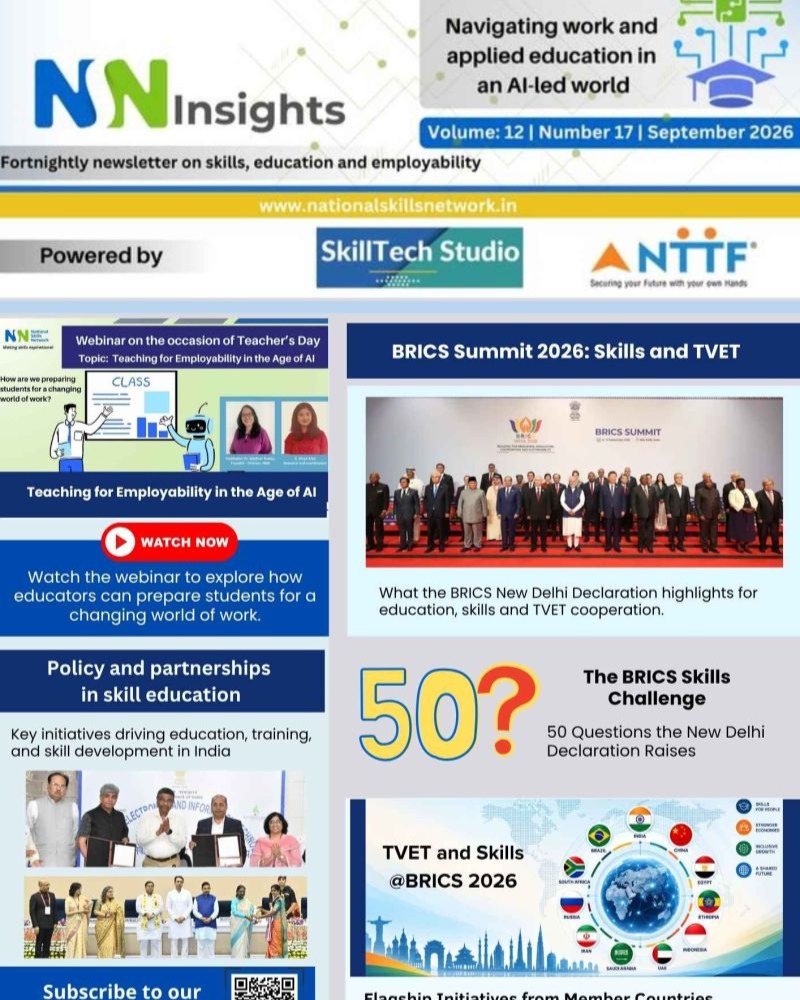
  • From AI in school education to evolving careers in the insurance sector, the focus on skills is becoming more defined across stages of learning and work.In the latest edition, we bring together key themes:• AI and computational thinking are introduced at the school level
• Emerging career opportunities in the insurance industry
• The growing importance of employability skills
• The gap between education and industry expectationsThese shifts highlight a clear direction; skills are central to how education and careers are evolving.Click here to read the latest edition of NSN Insights and explore more - https://sendy.nationalskillsnetwork.in//w/hzLT7swDQzH4qANAeEmr4A#SkillDevelopment #Employability #AIinEducation #Careers #SkillIndia #AI
  • As AI continues to shape how we learn and work, building practical AI skills is becoming increasingly important across sectors.Initiatives like YUVA AI for All under the IndiaAI Mission are helping make AI learning more accessible through structured, short-duration courses, regional language support, and hands-on approaches.From understanding AI fundamentals to learning how to effectively prompt and apply AI tools, the focus is clearly shifting toward real-world usage and human + AI collaboration.Know more: https://nationalskillsnetwork.in/yuva-ai-for-all-explained/#AI #AISkills #IndiaAI #FutureOfWork #SkillDevelopment
  • Key developments this week highlight how India’s skilling ecosystem is advancing through policy reforms, industry collaboration and emerging technologies.From the launch of the Skills Outcomes Fund and record growth in apprenticeships to new AI programmes, scholarships and sector-specific training initiatives, the focus continues to be on building a future-ready workforce.Efforts across healthcare, manufacturing and creative industries are further strengthening pathways to employment.Explore the key highlights in this week’s NSN Newsbytes: https://nationalskillsnetwork.in/newsbytes-skill-education-14-april-2026/#SkillDevelopment #CSR #Apprenticeships #AI #VocationalEducation
  • COL-CEMCA Conducts Three-Day Workshop on Graduate Employability at YCMOU, Nashik, MaharashtraDr. Madhuri Dubey, Founder-Director, NSN, facilitated the workshop as a part of the Commonwealth of Learning - Commonwealth Educational Media Centre for Asia (CoL-CEMCA) Project on enhancing graduate employability by integrating appropriate skills into the curriculum.The workshop was organized by CoL-CEMCA in collaboration with Yashwantrao Chavan Maharashtra Open University (YCMOU), Nashik, from 10th to 12th March, 2026, at the YCMOU campus in Nashik, Maharashtra under the guidance of Dr. B. Shadrach, Director, CEMCA and Dr Jane Agbu , Adviser Higher Education, Commonwealth of Learning.
The workshop was inaugurated by Prof. Sanjeev Sonawane, honourable Vice-Chancellor, YCMOU, and coordinated by Dr. Amol Shirfule, Director i/c, Yash Center for Innovation, Incubation and Linkages and Dr. Nagarjun Wadekar, Director, School of Social Sciences and Humanities, YCMOU.As a part of the comprehensive Graduate Employability Project, the workshop brought together academic leaders representing different schools of specialization, course coordinators, and faculty members from YCMOU to strengthen curriculum design with a focus on employability skills and industry relevance.The workshop emphasised the transition from traditional content-driven teaching to outcome-based education using the Results-Based Management (RBM) Framework. Participants engaged in discussions and practical exercises to align learning outcomes with professional competencies and labour market needs.#employability #openuniversity #graduates #skills #education

About us

National Skills Network (NSN) captures and shares the positive impact of various training, skill development and vocational education initiatives in India.

To know more about Our Team: Click here

Address

NSN Digital Solutions Pvt. Ltd.
CIN: U74999TG2020PTC147299
MSME: UDYAM-TS-09-0086473
Gachibowli, Hyderabad – 500032

Email us: contact@nationalskillsnetwork.com

Important Links

  • Conversations
  • Perspectives
  • News
  • Skill Development e-Magazine
  • Resources
  • Our Team
  • Our Clients
  • Partner with us
  • About us
  • Advertise with us
  • Content Disclaimer
  • Privacy Policy

© 2026 National Skills Network Content licensed under CC BY-ND 4.0. Commercial use requires permission.

loader
No Result
View All Result
  • Home
  • Conversations
    • Industry Conversations
    • All Conversations
  • Perspectives
    • Education
    • Emerging Technologies
    • Government Initiatives
    • Industry
    • Industrial Training Institutes (ITIs)
    • NEP 2020
    • Skill Training
  • News
    • Latest Updates
    • News Archives
    • CSR and ESG in Skill Education
    • Skill Development e-Magazine
    • NSN PDF Newsletter Archives
  • Videos
    • Explainers
    • Panel Discussions
    • Student Stories
    • Video Conversations
  • Resources
    • Apprenticeship
    • e-Books
    • Resources
    • Success Stories
  • Events
    • Workshops
  • About us
    • Our Team
    • Our Clients
    • Our Services
    • Privacy Policy

© 2026 National Skills Network Content licensed under CC BY-ND 4.0. Commercial use requires permission.