NSN
slider image
  • Home
  • Conversations
    • Industry Conversations
    • All Conversations
  • Perspectives
    • Education
    • Emerging Technologies
    • Government Initiatives
    • Industry
    • Industrial Training Institutes (ITIs)
    • NEP 2020
    • Skill Training
  • News
    • Latest Updates
    • News Archives
    • CSR and ESG in Skill Education
    • Skill Development e-Magazine
    • NSN PDF Newsletter Archives
  • Videos
    • Explainers
    • Panel Discussions
    • Student Stories
    • Video Conversations
  • Resources
    • Apprenticeship
    • e-Books
    • Resources
    • Success Stories
  • Events
    • Workshops
  • About us
    • Our Team
    • Our Clients
    • Our Services
    • Privacy Policy
No Result
View All Result
NSN
  • Home
  • Conversations
    • Industry Conversations
    • All Conversations
  • Perspectives
    • Education
    • Emerging Technologies
    • Government Initiatives
    • Industry
    • Industrial Training Institutes (ITIs)
    • NEP 2020
    • Skill Training
  • News
    • Latest Updates
    • News Archives
    • Skill Development e-Magazine
    • NSN PDF Newsletter Archives
  • Resources
    • Apprenticeship
    • E-books
    • Resources
    • Success Stories
  • Events
    • Workshops
  • About us
    • Our Team
    • Our Clients
    • Our Services
    • Privacy Policy
NSN
No Result
View All Result
Home Perspectives Emerging Technologies

5 Imperatives to make ITI courses aspirational

Guest Author by Guest Author
March 10, 2022
Reading Time: 5 mins read
A A
0

TCS iON Vocational Education

Guest Author: Ranjan Choudhury, Head Partnerships, Vocational Education, TCS iON

Plumber, Fitter, Carpenter, Electrician – these are the courses that come to our mind when we think of ITIs.  ITIs, however, have moved beyond the typical trades that prepare the youth to become semi-skilled or skilled workers in traditional job roles. Even though most courses under the Craftsman Training Scheme (CTS) cater to the services industry and there is a provision to include Industry 4.0 and Drone Technology, the general perception of ITIs is limited to a few trades.

The fact that several ITIs have many more courses in both manufacturing and non-manufacturing categories is hardly known to students who aspire for good quality technical training that can land them jobs with respectable salaries. Besides awareness, the image of an ITI is an issue. Since, today, technical training and education must adopt new ways to design and deliver courses that meet the dynamic demands of the industry. And, what about placements? How often do we hear the course completion story of students who excel, innovate and perform well on the job and get appreciated by the industry?

Answers to these questions will help in understanding how the courses can be made aspirational, attractive and relevant.  Let’s look at five imperatives that can open up new thought and action to build the aspirational elements in ITI courses:

  1. 21st Century branding and awareness

The future of any education and training institution depends on the number of students it attracts and the quality of training it delivers. On this account, ITIs need to fast-track their reforms to stay relevant and reinvent to meet the aspirations of multiple stakeholders – industry, students, trainers, parents and principals of ITIs (technical training leadership – currently lacking) and make it sustainable, profitable and relevant.

This could be a business imperative for private ITIs – all the more so because the cost of technical training is high and it cannot be subsidised drastically. And this impacts the course fee and its affordability.

Branding the courses as an ideal option for school dropouts, low achievers, ITIs have already limited their outreach. By confining it to a certain group of students, the image of technical training is further lowered and devalues its social acceptance. Therefore, there is a need for ITIs to offer programs in trending topics to attract students from all walks.

  1. Sustainable industry collaboration

In an ideal setup, ITIs are expected to work closely with the industry and many ITIs are located in close proximity to industry clusters. Since technical training needs a continuous collaboration with various industry sectors for it to be of high quality, we need innovative approaches to break new grounds. Setting up an Institute Management Committee (IMC) under Public-Private Partnership (PPP) has been one of the key initiatives in this regard.

However, not all ITIs could accomplish such partnerships with large companies. While it may be unrealistic to expect large corporate organizations to ‘adopt’ many more ITIs and strengthen the ecosystem, we need to probe how medium and small enterprises can be encouraged to partner. Can we engage them through apprenticeships and faculty development programs in ITIs that are close to their industrial premises?

5 Imperatives to make ITI courses aspirational

  1. Technology adoption and phygital model

Many doubts regarding the feasibility of offering technical training through online mode are put to rest with the COVID-19 push to use technology. With blended and phygital forms of learning, today’s technical training can be re-imagined and implemented at scale, without compromising on quality.

Nevertheless, for many ITIs, establishing a strong and robust technology system could be out of reach both financially and operationally. And, it’s quite a challenge to explore and secure funding to build it from scratch. It makes good business sense for them to partner with established, leading players in online training and design blended models for course delivery for anytime-anywhere learning using any device.

  1. New-age technical courses and capacity building

With the emergence of digital enterprises, every industry is getting disrupted through the innovative use of technology. This has a clear impact on the job roles that ITI students can aspire for. In fact, one of the strategies to attract students is to offer courses that are trending with an optimal balance of theory and practical learning.

How do we implement suitable changes in the curriculum and build capacity to offer new-age courses? How do we enable ITIs to initiate such changes, especially when the focus is on enabling all the students to appear for the All-India Trade Test (AITT) to get NCVT certificate? What about upskilling of instructors in relevant disciplines? The answer, to a large extent, lies in continuous industry-ITI interaction and engagement that’s goes beyond student placements.

  1. Multi-skilling for the new world of work

The changing world of work fuelled by the gig economy necessitates a re-look at how the courses can be bundled and presented to the students. Instead of focusing on a set of skills pertaining to a job role, we should rather explore if a course can be designed for multi-sector employment.

For example, students of the Auto Technician course can benefit if they can get training in being a Solar Technician as well to help switch to a different job if need be. Along with it, a well-curated module in life skills or 21st-century skills such as building resilience, agility and other transferable skills can prepare them for the future workplace.

In addition, implementing NSQF-aligned credits and options for equivalence through NIOS courses would complement efforts towards enhancing the value of ITI courses.

The points above discussed the five imperatives to transform the image and outcome of technical training in India, especially the common perception of courses offered by various ITIs. For many private ITIs, it would open up new avenues to increase their intake and engage with the industry for collaborative innovation and sustainable impact.

RelatedPosts

YUVA AI for All: Government of India’s Free AI Course Under IndiaAI Mission

AI for Beginners: Online Free Courses from MSDE through SOAR

Humans in the Loop: Entry-level jobs in Artificial Intelligence (AI)

Click here to know more about programs offered by TCS iON in technical and vocational education – https://learning.tcsionhub.in/hub/ve/

For more information about TCS iON phygital model for vocational education please email at tcsion.ve@tcs.com

Tags: Industrial Training InstitutesIndustry collaborationITIITI CoursesMulti-sector skillingskill developmentTCS iONTCS iON phygital platformtechnical training institutionVocational Training
ShareTweetShareSummarizeSummarize
WhatsApp Join our WhatsApp channel for more updates:
WhatsApp Join Now!
YouTube Subscribe to our YouTube channel for more updates:
YouTube Subscribe Now!
Previous Post

Certif-ID: A New Credentialing Ecosystem On Blockchain

Next Post

Types of welding: MIG Welding and TIG Welding

Guest Author

Guest Author

Next Post
Types of welding MIG Welding and TIG Welding

Types of welding: MIG Welding and TIG Welding

Leave a Reply Cancel reply

Your email address will not be published. Required fields are marked *

No Result
View All Result
samplead3 samplead1

Subscribe to our e-Magazine

Trending Topics

skilling in India (131) National Skill Development Corporation - NSDC (127) skill development news India (125) skill development (118) Ministry of Skill Development and Entrepreneurship MSDE (102) vocational education (97) Apprenticeships (90) skill development news (81) NEP 2020 (73) skill development programs (71)

Follow us

  • National Skills Network-NSN celebrates 11 years!!We are grateful for your continued support and engagement over the years. It has been central to this journey. This milestone reflects both our journey and the ecosystem we’ve engaged with.Over the last decade, we’ve observed and gained a clear perspective on how education, skills, and careers are evolving across the ecosystem.And one insight continues to stand out.The gap is no longer about skills awareness.The gap is in the transition from education to employability.To strengthen a complex, fragmented, but evolving ecosystem, a shift is needed.Many pathways are still shaped by compromise, confusion, or circumstance, making the system largely reactive.From reactive responses
- to proactive pathwaysWhere:
💠Skills are integrated into education early
💠Learning is connected to real-world application
💠Employability is built into the systemAs NSN marks 11 years, we remain focused on contributing to this shift through deeper engagement, conversations, and collaborations across the ecosystem.If this resonates with your work, let us know how you would like to engage with NSN. Scan the code to connect!#NSN11Years #workanniversary #skilldevelopment #employability #education
  • Why do skills matter more than degrees in the gig economy?As the gig economy continues to grow, online freelancing and platform-based work are becoming important career pathways for young people. However, most education and training systems are still focused on traditional job models, creating a gap between learning and real-world work.In this conversation, Dr. Madhuri Dubey, Ph.D, Founder Director, National Skills Network-NSN, speaks with Ms. Pooja Gianchandani, Global Lead – Skills for Gig Economy at GIZ Germany, to discuss:What gig work really includes:💠The difference between location-based work and online freelancing
💠Why learners are not fully prepared for gig and platform work
💠Key challenges in freelancing and digital work
💠How the Online Freelancer Training (OFT) Toolkit helps bridge this gap
💠The importance of technical, transversal, and transitional skills
💠Why a mindset shift is critical for the future of workWatch the full conversation to understand how skills training needs to evolve for the gig economy - https://youtu.be/9TQjkLPSolo?si=MuUH4pmDiQBPPd8b#gigeconomy #gigwork #platformwork #onlinefreelancing #toolkit #GIZ
  • From internships and sector-specific skills to training infrastructure and policy frameworks, multiple developments are shaping how skills are built and delivered.In the latest edition of NSN Insight, explore:• Key updates on the PM Internship Scheme 2026
• Skill requirements and emerging roles in the Textile and BFSI sectors
• The role and impact of Sector Skill Councils
• ROI of modern training tools and setting up skill training centres
• NCVET’s role in recognition, accreditation, and evolving frameworks
• A quick quiz to test your understanding of Sector Skill CouncilsClick here to read the latest edition of NSN Insights and explore more - https://sendy.nationalskillsnetwork.in//w/g7gCNS8rXg892X65Z5tjz2iA#skilldevelopment #BFSI #textileindustry #internships #training #NCVET
  • 7 Practical Ways to Improve Graduate Employability in IndiaGraduate employability continues to be a critical challenge, with a clear gap between education and industry expectations. It’s not just about skills anymore; it’s about readiness, exposure, and the ability to apply learning in real-world contexts.In our latest article, we explore 7 practical ways to improve graduate employability in India, to help individuals and institutions take actionable steps.Read more: https://nationalskillsnetwork.in/graduate-employability-india-7-ways/#graduateemployability #skilldevelopment #highereducation #employability
  • Applications for the Prime Minister Internship Scheme 2026 are now open, offering paid internship opportunities with a ₹9,000 monthly stipend and hands-on experience with leading companies.With updated guidelines, flexible duration, and a focus on real workplace exposure, the scheme aims to strengthen employability and provide a clear pathway from education to industry.Learn more about the eligibility, key updates, benefits, and how to apply.Click here to read more: https://nationalskillsnetwork.in/pm-internship-scheme-2026-updates/#PMInternshipScheme #PMIS2026 #Internships #SkillDevelopment #Employability
  • India’s digital journey is entering a new phase where artificial intelligence is becoming part of everyday learning, work, and decision-making. The YUVA AI for All course, introduced under the IndiaAI Mission, is designed to make AI learning simple, practical, and accessible to learners from all backgrounds.This structured course helps individuals understand AI fundamentals, explore real-world applications, and build the confidence to work with AI tools effectively, ensuring that AI is not limited to experts but becomes a skill for everyone.#Yuvaai #artificialintelligence #aiskills #aitools
  • Financial Skills and Education for School and College StudentsFinancial literacy is increasingly being recognised as a core life skill for students. As young people navigate digital transactions, changing career pathways, and financial responsibilities, early exposure to money management and financial concepts becomes essential.In this article, explore how financial education can move beyond basic awareness to build practical understanding. From covering decision-making, risk, markets, and long-term financial thinking.It also highlights the role of schools and colleges in preparing students to engage confidently with real-world financial situations.Read more: https://nationalskillsnetwork.in/financial-skills-education-for-students/#financialliteracy #financialeducation #schooleducation #highereducation #finance
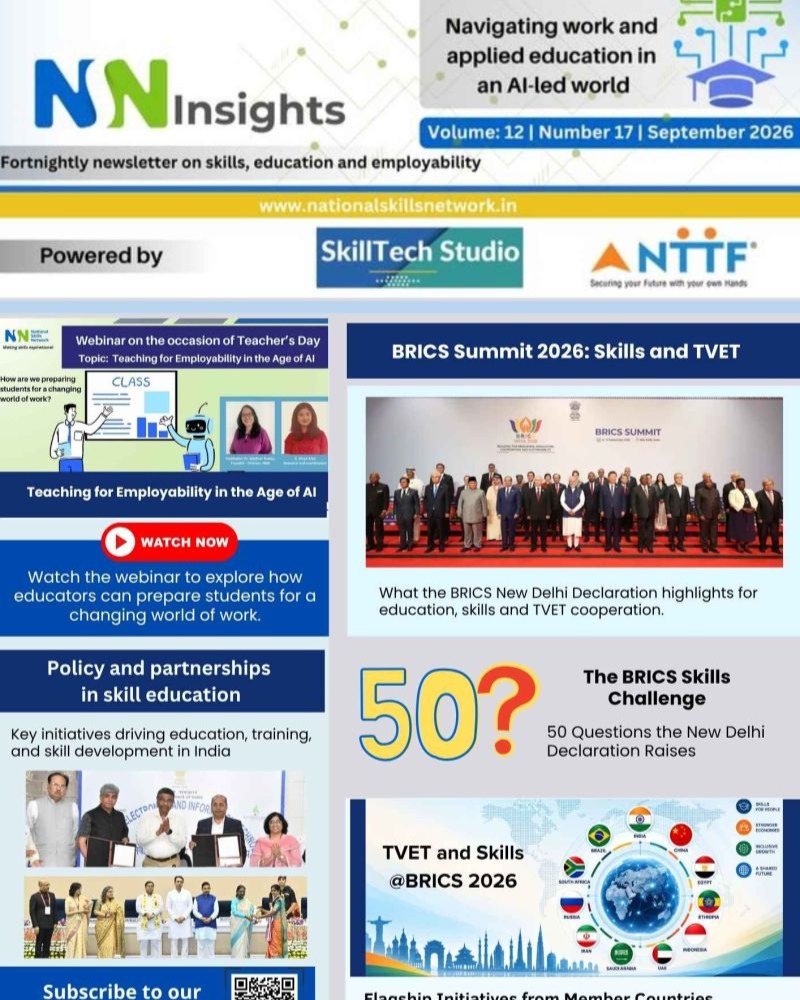
  • From AI in school education to evolving careers in the insurance sector, the focus on skills is becoming more defined across stages of learning and work.In the latest edition, we bring together key themes:• AI and computational thinking are introduced at the school level
• Emerging career opportunities in the insurance industry
• The growing importance of employability skills
• The gap between education and industry expectationsThese shifts highlight a clear direction; skills are central to how education and careers are evolving.Click here to read the latest edition of NSN Insights and explore more - https://sendy.nationalskillsnetwork.in//w/hzLT7swDQzH4qANAeEmr4A#SkillDevelopment #Employability #AIinEducation #Careers #SkillIndia #AI
  • As AI continues to shape how we learn and work, building practical AI skills is becoming increasingly important across sectors.Initiatives like YUVA AI for All under the IndiaAI Mission are helping make AI learning more accessible through structured, short-duration courses, regional language support, and hands-on approaches.From understanding AI fundamentals to learning how to effectively prompt and apply AI tools, the focus is clearly shifting toward real-world usage and human + AI collaboration.Know more: https://nationalskillsnetwork.in/yuva-ai-for-all-explained/#AI #AISkills #IndiaAI #FutureOfWork #SkillDevelopment

About us

National Skills Network (NSN) captures and shares the positive impact of various training, skill development and vocational education initiatives in India.

To know more about Our Team: Click here

Address

NSN Digital Solutions Pvt. Ltd.
CIN: U74999TG2020PTC147299
MSME: UDYAM-TS-09-0086473
Gachibowli, Hyderabad – 500032

Email us: contact@nationalskillsnetwork.com

Important Links

  • Conversations
  • Perspectives
  • News
  • Skill Development e-Magazine
  • Resources
  • Our Team
  • Our Clients
  • Partner with us
  • About us
  • Advertise with us
  • Content Disclaimer
  • Privacy Policy

© 2026 National Skills Network Content licensed under CC BY-ND 4.0. Commercial use requires permission.

loader
No Result
View All Result
  • Home
  • Conversations
    • Industry Conversations
    • All Conversations
  • Perspectives
    • Education
    • Emerging Technologies
    • Government Initiatives
    • Industry
    • Industrial Training Institutes (ITIs)
    • NEP 2020
    • Skill Training
  • News
    • Latest Updates
    • News Archives
    • CSR and ESG in Skill Education
    • Skill Development e-Magazine
    • NSN PDF Newsletter Archives
  • Videos
    • Explainers
    • Panel Discussions
    • Student Stories
    • Video Conversations
  • Resources
    • Apprenticeship
    • e-Books
    • Resources
    • Success Stories
  • Events
    • Workshops
  • About us
    • Our Team
    • Our Clients
    • Our Services
    • Privacy Policy

© 2026 National Skills Network Content licensed under CC BY-ND 4.0. Commercial use requires permission.