NSN
slider image
  • Home
  • Conversations
    • Industry Conversations
    • All Conversations
  • Perspectives
    • Education
    • Emerging Technologies
    • Government Initiatives
    • Industry
    • Industrial Training Institutes (ITIs)
    • NEP 2020
    • Skill Training
  • News
    • Latest Updates
    • News Archives
    • CSR and ESG in Skill Education
    • Skill Development e-Magazine
    • NSN PDF Newsletter Archives
  • Videos
    • Explainers
    • Panel Discussions
    • Student Stories
    • Video Conversations
  • Resources
    • Apprenticeship
    • e-Books
    • Resources
    • Success Stories
  • Events
    • Workshops
  • About us
    • Our Team
    • Our Clients
    • Our Services
    • Privacy Policy
No Result
View All Result
NSN
  • Home
  • Conversations
    • Industry Conversations
    • All Conversations
  • Perspectives
    • Education
    • Emerging Technologies
    • Government Initiatives
    • Industry
    • Industrial Training Institutes (ITIs)
    • NEP 2020
    • Skill Training
  • News
    • Latest Updates
    • News Archives
    • Skill Development e-Magazine
    • NSN PDF Newsletter Archives
  • Resources
    • Apprenticeship
    • E-books
    • Resources
    • Success Stories
  • Events
    • Workshops
  • About us
    • Our Team
    • Our Clients
    • Our Services
    • Privacy Policy
NSN
No Result
View All Result
Home Conversations

Applied Learning for Skill Education in Schools: A Perspective from Victoria, Australia

S. Divya Sree by S. Divya Sree
March 25, 2026
Reading Time: 5 mins read
A A
0

The conversation around skills is no longer about whether they matter; it is about how early and how effectively they are integrated into education. As systems worldwide respond to changing workforce demands, the shift from knowledge-heavy learning to application-driven education is becoming more visible.

In India, with the momentum of NEP 2020, applied learning, vocational integration, and work-based education are gaining ground. However, the real challenge lies in how learning is delivered, how teachers adapt, and how these pathways are perceived.

Insights from global practices can help decode this transition. In this conversation we spoke with Ms. Helene Rooks, CEO of the Victorian Applied Learning Association (VALA), Australia, to understand how applied learning is embedded at the school level, how teachers are supported, and how advocacy has played a role in strengthening vocational education pathways.

Below are a few excerpts from our conversation. You can watch the full video on our YouTube channel.

Q. Can you tell us more about VALA, its objective, your motivation, and how it has evolved over the years?

A. VALA has been working in the applied learning space for over 20 years, supporting teachers and educators, particularly at the secondary school level. The work is both challenging and rewarding, especially in a time when education systems are constantly evolving.

The core belief is that vocational and applied learning is not limited to a specific group of students; it is relevant for everyone.

Applied learning is not a certificate or a separate stream. It is a way of teaching, a pedagogy that focuses on:

  • Learning through doing
  • Connecting knowledge to real-world contexts
  • Moving beyond textbook-based instruction

When discussing skills, the focus goes beyond technical abilities. Equal importance is given to what are often called 21st-century skills; referred to here as power skills, which include critical thinking, communication, and adaptability.

These are essential for young people entering the workforce, especially in a rapidly changing environment.

Q. How does the applied learning ecosystem work in Victoria, particularly with VCE Vocational Major, and how is it being received?

A. Both India and Victoria are moving towards embedding vocational education within mainstream schooling. The earlier system in Victoria, the Victorian Certificate of Applied Learning (VCAL), was designed to address diverse learner needs but faced reputational challenges, which is a common issue globally.

A major reform led to the introduction of the VCE Vocational Major (VCE VM), bringing applied learning into the broader school framework.

The response has been significant, with a notable increase in student participation.

The VCE VM includes:

  • Personal development skills
  • Work-related skills
  • Literacy and numeracy
  • A mandatory vocational education and training (VET) component

Students have multiple pathways within this structure. They can choose coursework in vocational areas or opt for school-based apprenticeships, where learning is split between school, workplace, and training providers.

This model allows students to:

  • Gain real-world exposure early
  • Earn while learning in some cases
  • Progress faster in their chosen vocational pathway

Importantly, this pathway does not limit future options. Students can still move into higher education through alternative entry routes, and the vocational components align with broader systems like TAFE.

Q. How does VALA support professional development of teachers and educators?

A. The first step in applied learning is a shift in mindset. Traditional teaching methods do not translate effectively into this approach.

Teachers need to move from being content deliverers to facilitators of learning.

This involves:

  • Letting go of control in the classroom
  • Giving students more responsibility
  • Building strong relationships with learners

Understanding the student becomes central; not just academically, but also emotionally and socially. Learning is then designed around the student’s context and interests.

Applied Learning for Skill Education in Schools A Perspective from Victoria, Australia

While this approach may seem intensive initially, it leads to stronger engagement and better outcomes over time.

VALA supports educators through a range of initiatives:

  • Induction programs for teachers new to applied learning
  • Practical guidance on implementing curriculum in classrooms
  • Webinars and customised masterclasses
  • Training on managing complex program structures like VCE VM
  • Subject-specific sessions, including applied approaches to numeracy

In addition to professional development, advocacy plays a critical role.

Key efforts include:

RelatedPosts

7 Practical Ways to Improve Graduate Employability in India

Insurance Industry in India: Skills, Careers and the Impact of AI

National Welding League for Women 2026: Boosting skills and careers through competitions

  • Ensuring applied learning principles are included in curriculum reforms
  • Addressing disparities between academic and vocational pathways
  • Advocating for equal recognition and funding, especially during disruptions like COVID

The focus remains on ensuring that all learning pathways are valued equally.

Q. With the future focusing on applying knowledge and skills, what is your message to educators and learners?

A. There is a clear shift in what employers expect from young people entering the workforce.

The emphasis is increasingly on:

  • Critical thinking
  • Communication
  • Digital literacy

If these foundational skills are strong, technical skills can be taught on the job.

In a world shaped by artificial intelligence and rapid change, the ability to apply knowledge, solve problems, and communicate effectively becomes more important than memorising information.

The focus is no longer just on what students know, but on what they can do with that knowledge.

Also read: Applied Learning in Secondary Schools: A toolkit for teachers, school leaders and teacher educators

Q. What advice would you give for teachers?

A. There has been a long-standing perception that vocational and applied learning pathways are secondary or less valuable. This has led to a lack of confidence among both educators and students.

That perception needs to change.

Be confident and take pride in:

  • The role of teaching
  • The value of applied learning
  • The achievements of students

Every learner brings value, and education should not be defined by a single standard.

Changing how skills and vocational education are perceived starts with how educators and institutions present and advocate for them.

Tags: applied learningApplied Learning in Schoolsschool educationskill educationTeacher TrainingTechnical and Further Education (TAFE)VET Vocational Education and TrainingVictorian Certificate of Education VCEwork-based learning
ShareTweetShareSummarizeSummarize
WhatsApp Join our WhatsApp channel for more updates:
WhatsApp Join Now!
YouTube Subscribe to our YouTube channel for more updates:
YouTube Subscribe Now!
Previous Post

Weekly Newsbytes from NSN on Skill Development and Education – 24th March 2026

Next Post

NSN Quiz on Electric Vehicles (EV), Skills and Jobs

S. Divya Sree

S. Divya Sree

S. Divya Sree is a Content Developer at National Skills Network (NSN), covering topics related to education, technology, work-integrated learning, and skill development. She is passionate about creating digital content, fond of research and analysis, and believes in the role of education and skilling in shaping the future of work.

Next Post
NSN Quiz on Electric Vehicles (EV), Skills and Jobs

NSN Quiz on Electric Vehicles (EV), Skills and Jobs

Leave a Reply Cancel reply

Your email address will not be published. Required fields are marked *

No Result
View All Result
samplead3 samplead1

Subscribe to our e-Magazine

Trending Topics

skilling in India (131) National Skill Development Corporation - NSDC (127) skill development news India (125) skill development (117) Ministry of Skill Development and Entrepreneurship MSDE (102) vocational education (97) Apprenticeships (90) skill development news (81) NEP 2020 (72) skill development programs (71)

Follow us

  • COL-CEMCA Conducts Three-Day Workshop on Graduate Employability at YCMOU, Nashik, MaharashtraDr. Madhuri Dubey, Founder-Director, NSN, facilitated the workshop as a part of the Commonwealth of Learning - Commonwealth Educational Media Centre for Asia (CoL-CEMCA) Project on enhancing graduate employability by integrating appropriate skills into the curriculum.The workshop was organized by CoL-CEMCA in collaboration with Yashwantrao Chavan Maharashtra Open University (YCMOU), Nashik, from 10th to 12th March, 2026, at the YCMOU campus in Nashik, Maharashtra under the guidance of Dr. B. Shadrach, Director, CEMCA and Dr Jane Agbu , Adviser Higher Education, Commonwealth of Learning.
The workshop was inaugurated by Prof. Sanjeev Sonawane, honourable Vice-Chancellor, YCMOU, and coordinated by Dr. Amol Shirfule, Director i/c, Yash Center for Innovation, Incubation and Linkages and Dr. Nagarjun Wadekar, Director, School of Social Sciences and Humanities, YCMOU.As a part of the comprehensive Graduate Employability Project, the workshop brought together academic leaders representing different schools of specialization, course coordinators, and faculty members from YCMOU to strengthen curriculum design with a focus on employability skills and industry relevance.The workshop emphasised the transition from traditional content-driven teaching to outcome-based education using the Results-Based Management (RBM) Framework. Participants engaged in discussions and practical exercises to align learning outcomes with professional competencies and labour market needs.#employability #openuniversity #graduates #skills #education
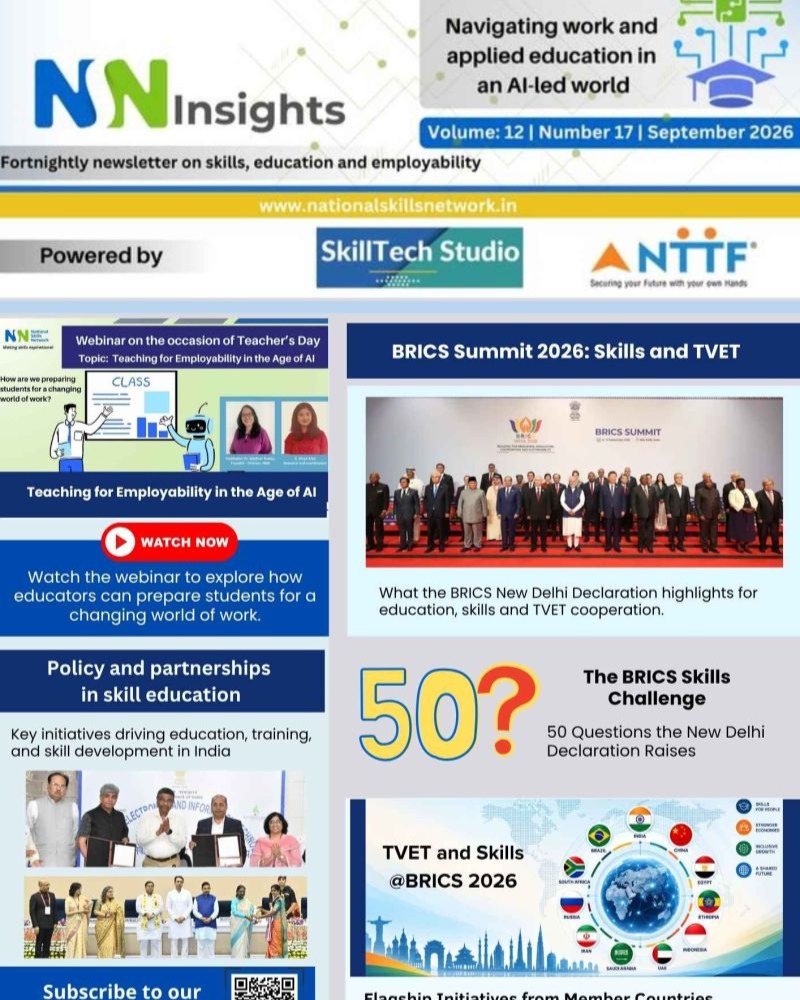
  • The conversation around skills and education in India continues to evolve, with a growing focus on employability, industry relevance, and future-ready careers.From applied learning in schools to emerging opportunities in sectors like electric vehicles and the increasing importance of transferable skills, the shift is clearly towards building a more adaptable and skilled workforce.In the latest edition, we also cover key developments across policy, industry collaborations, and skilling initiatives shaping the ecosystem.Explore the latest edition of NSN Insights to know more - https://sendy.nationalskillsnetwork.in//w/QSEDv2CnW892B3SndfpAHoXw#skilldevelopment #employabilityskills #appliedlearning #EVjobs #NEP2020
  • Applied Learning for Skill Education in Schools: A Perspective from Victoria, AustraliaThe shift in education is clear; it’s no longer about what students know, but what they can do.As India advances with NEP 2020, applied learning and skill-based education are becoming central. But the real change lies in how we teach and enable students to apply knowledge in real-world contexts.In this conversation with Dr. Madhuri Dubey, Ph.D, Founder and Director, National Skills Network-NSN, speaks with Ms. Helene Rooks, CEO of the Victorian Applied Learning Association (VALA), we explore how applied learning is transforming education in Australia, through real-world learning, vocational pathways like VCE VM, and a strong focus on future skills.Watch the full video here -
https://youtu.be/fkhFm4iqzbA?si=ucyhgYzVruFQYArl
  • âš¡ How ready are you for the future of mobility?Electric Vehicles (EVs) are rapidly transforming the way we think about transportation, skills, and jobs. From battery technology to charging infrastructure, new opportunities are emerging across sectors.🧠 Take the NSN Quiz on Electric Vehicles (EVs), Skills and Jobs to test your understanding of EV basics, key concepts, and career pathways in this growing field.Whether you’re a student, educator, or professional, this quick quiz is a simple way to check your awareness and stay updated with evolving industry trends.👉 Try the quiz and share your score in the comments! https://nationalskillsnetwork.in/nsn-quiz-on-electric-vehicles-ev/#electricvehicles #EV #automotiveskills #greenskills #electricmobility #skilldevelopment #sustainability
  • We often talk about innovation, future skills, and employability.But the real foundation for all of this is built much earlier, in our schools.Students from PM SHRI Demonstration Multipurpose School (DMS), Bhopal, have developed a smart multi-sensor safety system that can detect gas leaks, fire, temperature, and humidity, along with real-time alerts.What makes this noteworthy is not just the outcome, but the learning process behind it.This is what happens when students move beyond textbooks and engage in hands-on, application-based learning.They don’t just understand concepts; they apply them to solve real-world problems.It’s a reminder that when students are given the right opportunities, guidance, and environment, their potential can translate into meaningful, practical solutions.As conversations around skill education and future readiness continue to grow, there is a clear need to create more such learning experiences in schools, where curiosity, experimentation, and problem-solving are at the core.Because that is where real learning begins.#skilldevelopment #education #studentinnovation #learningbydoing #educationtransformation #STEMEducation #younginnovators
  • Important Updates for ITIs: 150 Hours OJT Mandatory for ITI TraineesA major reform for ITIs in India introduces 150 hours of mandatory On-the-Job Training (OJT) for trainees enrolled in Industrial Training Institutes under the Craftsmen Training Scheme (CTS).The initiative aims to strengthen industry exposure, practical learning, and employability by integrating real workplace experience into ITI training.Read more: https://nationalskillsnetwork.in/itis-150-hours-ojt-mandatory-for-trainees/#ITIs #skilldevelopment #technicaleducation #vocationaltraining #skillIndia #CTS
  • A stronger push toward a future-ready skilling ecosystem is visible across policy, industry and education this week.From proposed reforms like a National Job Skilling Policy and a Skill Board to expanding apprenticeship opportunities, applied learning initiatives, and curriculum updates, such as PSSCIVE’s IIoT program, the focus is clearly on aligning skills with emerging industry needs.Industry partnerships and state-led efforts continue to create new pathways for youth across sectors.Explore the key highlights in this week’s NSN Newsbytes: https://nationalskillsnetwork.in/newsbytes-skill-education-24-march-2026/#skilldevelopment #vocationaleducation #CSR #apprenticeships #education
  • Women at the forefront, national-level skill achievements, and key developments shaping the skilling ecosystem.From career insights of women in technology and engineering to highlights from the National Welding League for Women 2026, along with updates on ITI reforms and industry-led initiatives, this edition brings together key stories from across the skilling ecosystem.👉 Explore the latest edition of NSN Insights here: https://sendy.nationalskillsnetwork.in//w/2Fcf2slT2SJryMuwkBs6sA#skilldevelopment #womenintech #STEM #education #welding #NWL2026
  • 🌙 Ramadan Mubarak!May this blessed occasion fill your days with joy, peace, and a prosperous year ahead.– From Team NSN#EidMubarak #RamadanMubarak #Eid2026 #Celebration

About us

National Skills Network (NSN) captures and shares the positive impact of various training, skill development and vocational education initiatives in India.

To know more about Our Team: Click here

Address

NSN Digital Solutions Pvt. Ltd.
CIN: U74999TG2020PTC147299
MSME: UDYAM-TS-09-0086473
Gachibowli, Hyderabad – 500032

Email us: contact@nationalskillsnetwork.com

Important Links

  • Conversations
  • Perspectives
  • News
  • Skill Development e-Magazine
  • Resources
  • Our Team
  • Our Clients
  • Partner with us
  • About us
  • Advertise with us
  • Content Disclaimer
  • Privacy Policy

© 2026 National Skills Network Content licensed under CC BY-ND 4.0. Commercial use requires permission.

loader
No Result
View All Result
  • Home
  • Conversations
    • Industry Conversations
    • All Conversations
  • Perspectives
    • Education
    • Emerging Technologies
    • Government Initiatives
    • Industry
    • Industrial Training Institutes (ITIs)
    • NEP 2020
    • Skill Training
  • News
    • Latest Updates
    • News Archives
    • CSR and ESG in Skill Education
    • Skill Development e-Magazine
    • NSN PDF Newsletter Archives
  • Videos
    • Explainers
    • Panel Discussions
    • Student Stories
    • Video Conversations
  • Resources
    • Apprenticeship
    • e-Books
    • Resources
    • Success Stories
  • Events
    • Workshops
  • About us
    • Our Team
    • Our Clients
    • Our Services
    • Privacy Policy

© 2026 National Skills Network Content licensed under CC BY-ND 4.0. Commercial use requires permission.