NSN
slider image
  • Home
  • Conversations
    • Industry Conversations
    • All Conversations
  • Perspectives
    • Education
    • Emerging Technologies
    • Government Initiatives
    • Industry
    • Industrial Training Institutes (ITIs)
    • NEP 2020
    • Skill Training
  • News
    • Latest Updates
    • News Archives
    • CSR and ESG in Skill Education
    • Skill Development e-Magazine
    • NSN PDF Newsletter Archives
  • Videos
    • Explainers
    • Panel Discussions
    • Student Stories
    • Video Conversations
  • Resources
    • Apprenticeship
    • e-Books
    • Resources
    • Success Stories
  • Events
    • Workshops
  • About us
    • Our Team
    • Our Clients
    • Our Services
    • Privacy Policy
No Result
View All Result
NSN
  • Home
  • Conversations
    • Industry Conversations
    • All Conversations
  • Perspectives
    • Education
    • Emerging Technologies
    • Government Initiatives
    • Industry
    • Industrial Training Institutes (ITIs)
    • NEP 2020
    • Skill Training
  • News
    • Latest Updates
    • News Archives
    • Skill Development e-Magazine
    • NSN PDF Newsletter Archives
  • Resources
    • Apprenticeship
    • E-books
    • Resources
    • Success Stories
  • Events
    • Workshops
  • About us
    • Our Team
    • Our Clients
    • Our Services
    • Privacy Policy
NSN
No Result
View All Result
Home Perspectives Skill Training

Message from the President: Strengthening the Skill Ecosystem: What Training Providers can do?

Team NSN by Team NSN
January 17, 2019
Reading Time: 3 mins read
A A
0

ASTP Banner

Rajiv Sharma Empower Pragati
Rajiv Sharma, President, ASTP

Enough has been said about salvaging the demographic dividend of the country. What needs to be acknowledged is that mere governmental interventions are not sufficient to make the industry sustainable. All stakeholders have to initiate and collaborate on all fronts, to reap the benefits of the manpower that India produces. Any industry worldwide is considered successful when it is “demand-driven”. Skill sector of India should be driven by the demands that the service and manufacturing industry raises while taking youth aspirations into account. No industry can grow and flourish solely by government’s efforts. The implementers play a crucial role as well. In this backdrop, ASTP provides a platform for stakeholder engagement and partnerships to collectively learn, support and grow the ecosystem. Several steps can be taken to do so, some are listed below.

  1. Leverage our strength of training delivery

An alliance such as ASTP, gives a forum to the universe of Training Providers, where, we not only scrutinize existing policies but make thoughtful use of each other’s learnings and experience. By virtue of having a thought leadership, we have created a knowledge pool where all members have debated about ways in which skill industry can maximise its business and make our individual ventures more successful. Such deliberations will, in turn, benefit the entire ecosystem. Our latest focus is to develop training products whose selling point would be guaranteed employment and students would not mind paying for the same. This is a sure-shot way to make the industry demand-driven from both the employers and the students. Each of our member adds value to this initiative by coming with course-expertise, region-specific experience, demographic understanding and financial acumen. Together, this combination is bound to give expected results. By running huge government funded projects, we all have learnt the nuances of this industry and now is the time to leverage our strength of implementing skilling courses.

  1. Aggregation of demands

ASTP has been envisaged as a research body and one-of-a- kind industry specific think tank which will not only aggregate demands arising from the employers, recruiters and the youth but also create modules and models of training delivery. By aggregating such multi-dimensional demands, newer skilling opportunities can be created which students will proactively look out for. By making the industry demand-driven, we will also be able to achieve higher dignity of labour since such courses will gain popularity and youth will themselves be encouraged to enrol and secure a job. The target audience for skilling opportunities is not just the underprivileged and dropout population of the country but all those people who wish to make a career out of non-academic or non-professional courses. Such a population in our country is huge. All those students who score less than 70% in their senior school examination are forced to enrol into courses which will not yield them a job. To those students, quality vocational programmes can provide a viable option to make a respectable career. Mindsets will change and education will be approached with a transformed understanding.

  1. Collaborate in a highly competitive market

Most of the popular management theories suggest that all industries, at their initial juncture, require collaboration of efforts to finally be successful in economic and business terms. While competition is part of the game, collaboration brings in healthy and progressive growth. Training Providers need to realise their industry’s strength in totality and engage in participative forums such as ASTP. Energies have to be aligned to make the skill ecospace sustainable and less and less dependent on government business. We all have created our organisations by implementing government projects and have come a long way in understanding its advantages and disadvantages. Government can only support; intention of healthy growth has to come from TPs and all other stakeholders.

ASTP’s Vision 2020 incorporates these values and captures our plans for the growth of the alliance and simultaneously for the skill ecosystem. Together, members can create visibility by publishing success stories and develop positive PR. This will help build credibility within the sector and in the media. The alliance is progressing towards building a powerful and coherent skill ecosystem by including all stakeholders such as Sector Skill Councils, Content Creators, Assessment Agencies, and placement organisations among others. For continual and healthy growth, we are driven by ethical advocacy, high quality professional practices in training delivery, assessments or payment modalities. Gradually, impact of this drive and our efforts are bound to be visible. With that envisaged in our minds, I would like to congratulate our members for walking hand in hand and sharing a mind space to focus on the larger common good for sustainability of the ecosystem.

Rajiv Sharma,

President, ASTP and MD & Founder, Empower Pragati

RelatedPosts

Why skills over degrees matter for online freelancing in gig economy

IndiaSkills Competition 2025-26: Pathway to WorldSkills, Shanghai

Transferable Skills: Why they are essential for employability and career growth

Tags: Association of Skill Training Providers (ASTP)Rajiv Sharm President ASTPTraining providers
ShareTweetShareSummarizeSummarize
WhatsApp Join our WhatsApp channel for more updates:
WhatsApp Join Now!
YouTube Subscribe to our YouTube channel for more updates:
YouTube Subscribe Now!
Previous Post

ASTP Newsletter – Editorial – January 2019

Next Post

Ways to ensure industry collaboration for demand-driven training and successful placements

Team NSN

Team NSN

Next Post
ASTP Banner

Ways to ensure industry collaboration for demand-driven training and successful placements

Leave a Reply Cancel reply

Your email address will not be published. Required fields are marked *

No Result
View All Result
samplead3 samplead1

Subscribe to our e-Magazine

Trending Topics

skilling in India (131) National Skill Development Corporation - NSDC (127) skill development news India (125) skill development (118) Ministry of Skill Development and Entrepreneurship MSDE (102) vocational education (97) Apprenticeships (90) skill development news (81) NEP 2020 (73) skill development programs (71)

Follow us

  • National Skills Network-NSN celebrates 11 years!!We are grateful for your continued support and engagement over the years. It has been central to this journey. This milestone reflects both our journey and the ecosystem we’ve engaged with.Over the last decade, we’ve observed and gained a clear perspective on how education, skills, and careers are evolving across the ecosystem.And one insight continues to stand out.The gap is no longer about skills awareness.The gap is in the transition from education to employability.To strengthen a complex, fragmented, but evolving ecosystem, a shift is needed.Many pathways are still shaped by compromise, confusion, or circumstance, making the system largely reactive.From reactive responses
- to proactive pathwaysWhere:
💠Skills are integrated into education early
💠Learning is connected to real-world application
💠Employability is built into the systemAs NSN marks 11 years, we remain focused on contributing to this shift through deeper engagement, conversations, and collaborations across the ecosystem.If this resonates with your work, let us know how you would like to engage with NSN. Scan the code to connect!#NSN11Years #workanniversary #skilldevelopment #employability #education
  • Why do skills matter more than degrees in the gig economy?As the gig economy continues to grow, online freelancing and platform-based work are becoming important career pathways for young people. However, most education and training systems are still focused on traditional job models, creating a gap between learning and real-world work.In this conversation, Dr. Madhuri Dubey, Ph.D, Founder Director, National Skills Network-NSN, speaks with Ms. Pooja Gianchandani, Global Lead – Skills for Gig Economy at GIZ Germany, to discuss:What gig work really includes:💠The difference between location-based work and online freelancing
💠Why learners are not fully prepared for gig and platform work
💠Key challenges in freelancing and digital work
💠How the Online Freelancer Training (OFT) Toolkit helps bridge this gap
💠The importance of technical, transversal, and transitional skills
💠Why a mindset shift is critical for the future of workWatch the full conversation to understand how skills training needs to evolve for the gig economy - https://youtu.be/9TQjkLPSolo?si=MuUH4pmDiQBPPd8b#gigeconomy #gigwork #platformwork #onlinefreelancing #toolkit #GIZ
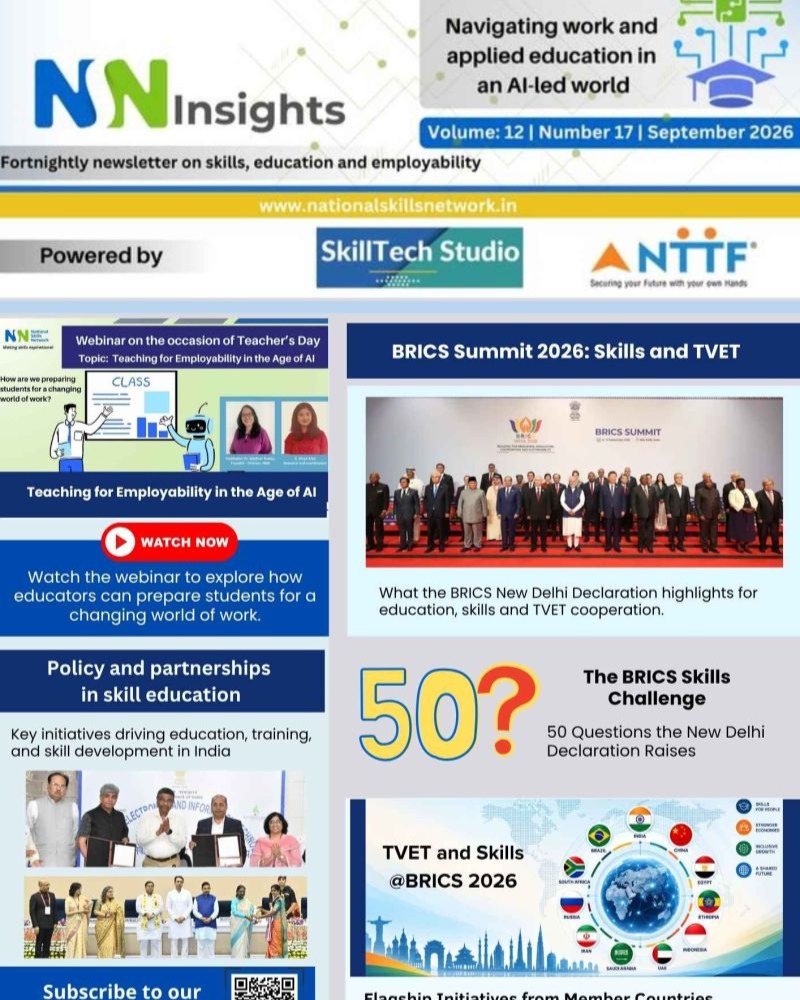
  • From internships and sector-specific skills to training infrastructure and policy frameworks, multiple developments are shaping how skills are built and delivered.In the latest edition of NSN Insight, explore:• Key updates on the PM Internship Scheme 2026
• Skill requirements and emerging roles in the Textile and BFSI sectors
• The role and impact of Sector Skill Councils
• ROI of modern training tools and setting up skill training centres
• NCVET’s role in recognition, accreditation, and evolving frameworks
• A quick quiz to test your understanding of Sector Skill CouncilsClick here to read the latest edition of NSN Insights and explore more - https://sendy.nationalskillsnetwork.in//w/g7gCNS8rXg892X65Z5tjz2iA#skilldevelopment #BFSI #textileindustry #internships #training #NCVET
  • 7 Practical Ways to Improve Graduate Employability in IndiaGraduate employability continues to be a critical challenge, with a clear gap between education and industry expectations. It’s not just about skills anymore; it’s about readiness, exposure, and the ability to apply learning in real-world contexts.In our latest article, we explore 7 practical ways to improve graduate employability in India, to help individuals and institutions take actionable steps.Read more: https://nationalskillsnetwork.in/graduate-employability-india-7-ways/#graduateemployability #skilldevelopment #highereducation #employability
  • Applications for the Prime Minister Internship Scheme 2026 are now open, offering paid internship opportunities with a ₹9,000 monthly stipend and hands-on experience with leading companies.With updated guidelines, flexible duration, and a focus on real workplace exposure, the scheme aims to strengthen employability and provide a clear pathway from education to industry.Learn more about the eligibility, key updates, benefits, and how to apply.Click here to read more: https://nationalskillsnetwork.in/pm-internship-scheme-2026-updates/#PMInternshipScheme #PMIS2026 #Internships #SkillDevelopment #Employability
  • India’s digital journey is entering a new phase where artificial intelligence is becoming part of everyday learning, work, and decision-making. The YUVA AI for All course, introduced under the IndiaAI Mission, is designed to make AI learning simple, practical, and accessible to learners from all backgrounds.This structured course helps individuals understand AI fundamentals, explore real-world applications, and build the confidence to work with AI tools effectively, ensuring that AI is not limited to experts but becomes a skill for everyone.#Yuvaai #artificialintelligence #aiskills #aitools
  • Financial Skills and Education for School and College StudentsFinancial literacy is increasingly being recognised as a core life skill for students. As young people navigate digital transactions, changing career pathways, and financial responsibilities, early exposure to money management and financial concepts becomes essential.In this article, explore how financial education can move beyond basic awareness to build practical understanding. From covering decision-making, risk, markets, and long-term financial thinking.It also highlights the role of schools and colleges in preparing students to engage confidently with real-world financial situations.Read more: https://nationalskillsnetwork.in/financial-skills-education-for-students/#financialliteracy #financialeducation #schooleducation #highereducation #finance
  • From AI in school education to evolving careers in the insurance sector, the focus on skills is becoming more defined across stages of learning and work.In the latest edition, we bring together key themes:• AI and computational thinking are introduced at the school level
• Emerging career opportunities in the insurance industry
• The growing importance of employability skills
• The gap between education and industry expectationsThese shifts highlight a clear direction; skills are central to how education and careers are evolving.Click here to read the latest edition of NSN Insights and explore more - https://sendy.nationalskillsnetwork.in//w/hzLT7swDQzH4qANAeEmr4A#SkillDevelopment #Employability #AIinEducation #Careers #SkillIndia #AI
  • As AI continues to shape how we learn and work, building practical AI skills is becoming increasingly important across sectors.Initiatives like YUVA AI for All under the IndiaAI Mission are helping make AI learning more accessible through structured, short-duration courses, regional language support, and hands-on approaches.From understanding AI fundamentals to learning how to effectively prompt and apply AI tools, the focus is clearly shifting toward real-world usage and human + AI collaboration.Know more: https://nationalskillsnetwork.in/yuva-ai-for-all-explained/#AI #AISkills #IndiaAI #FutureOfWork #SkillDevelopment

About us

National Skills Network (NSN) captures and shares the positive impact of various training, skill development and vocational education initiatives in India.

To know more about Our Team: Click here

Address

NSN Digital Solutions Pvt. Ltd.
CIN: U74999TG2020PTC147299
MSME: UDYAM-TS-09-0086473
Gachibowli, Hyderabad – 500032

Email us: contact@nationalskillsnetwork.com

Important Links

  • Conversations
  • Perspectives
  • News
  • Skill Development e-Magazine
  • Resources
  • Our Team
  • Our Clients
  • Partner with us
  • About us
  • Advertise with us
  • Content Disclaimer
  • Privacy Policy

© 2026 National Skills Network Content licensed under CC BY-ND 4.0. Commercial use requires permission.

loader
No Result
View All Result
  • Home
  • Conversations
    • Industry Conversations
    • All Conversations
  • Perspectives
    • Education
    • Emerging Technologies
    • Government Initiatives
    • Industry
    • Industrial Training Institutes (ITIs)
    • NEP 2020
    • Skill Training
  • News
    • Latest Updates
    • News Archives
    • CSR and ESG in Skill Education
    • Skill Development e-Magazine
    • NSN PDF Newsletter Archives
  • Videos
    • Explainers
    • Panel Discussions
    • Student Stories
    • Video Conversations
  • Resources
    • Apprenticeship
    • e-Books
    • Resources
    • Success Stories
  • Events
    • Workshops
  • About us
    • Our Team
    • Our Clients
    • Our Services
    • Privacy Policy

© 2026 National Skills Network Content licensed under CC BY-ND 4.0. Commercial use requires permission.