NSN
slider image
  • Home
  • Conversations
    • Industry Conversations
    • All Conversations
  • Perspectives
    • Education
      • Higher Education
      • School Education
    • Emerging Technologies
      • AI Skills and Education
    • Government Initiatives
    • Industry
    • Industrial Training Institutes (ITIs)
    • NEP 2020
    • Skill Training
  • News
    • Latest Updates
    • News Archives
    • CSR and ESG in Skill Education
    • Skill Development e-Magazine
    • NSN PDF Newsletter Archives
  • Videos
    • Explainers
    • Panel Discussions
    • Student Stories
    • Video Conversations
  • Resources
    • Apprenticeship
    • e-Books
    • Resources
    • Success Stories
  • Events
    • Workshops
  • About us
    • Our Team
    • Our Clients
    • Our Services
    • Privacy Policy
No Result
View All Result
NSN
  • Home
  • Conversations
    • Industry Conversations
    • All Conversations
  • Perspectives
    • Education
      • Higher Education
      • School Education
    • Emerging Technologies
      • AI Skills and Education
    • Government Initiatives
    • Industry
    • Industrial Training Institutes (ITIs)
    • NEP 2020
    • Skill Training
  • News
    • Latest Updates
    • News Archives
    • Skill Development e-Magazine
    • NSN PDF Newsletter Archives
  • Resources
    • Apprenticeship
    • E-books
    • Resources
    • Success Stories
  • Events
    • Workshops
  • About us
    • Our Team
    • Our Clients
    • Our Services
    • Privacy Policy
NSN
No Result
View All Result
Home Perspectives Skill Training

Voice of the ASTP Member : The evolving skills ecosystem in India and how it can be made more impactful

Madhuri Dubey by Madhuri Dubey
April 23, 2018
Reading Time: 5 mins read
A A
0

ASTP Banner

Dr Nalini Gangadharan, Chairperson – Trustee, CAP Foundation shares her perspective on the evolving skills ecosystem in India and how it can be made more impactful.

As a founding member of ASTP what would you like to say about the emerging skill-based/vocational training ecosystem in India. What are your observations about the programs that are being conducted, government schemes, role of CSR etc. ?

When we founded ASTP, the principal idea was to bring in some credibility and recognition to the training partner as an important stakeholder in the vocational training ecosystem. This was to be achieved with introduction of accountability, transparency, collaboration with the other stakeholders in the system and development of evidence-based advocacy for innovative and impactful practices at speed, scale and sustainability.

Though there has been many an attempt to introduce disruptive strategies and techniques, I would say ” the churning of the ocean” is still on. We should wait a bit more to find the elixir – that would make the training provider space recognised well enough.

Attempts at building accountability, transparency and scale are initiated and concrete results on sustainable models are yet to emerge.

What are some of the challenges you faced and how did you overcome them while implementing various training programs for employability enhancement , employment and self- employment? Give us an example.

As an organisation that has been in the skill-based vocational training space for long and much before the full-throttled efforts by the government, the focus was on using employability skills training as a transition support route to mainstream out-of-school young people to access the entry level jobs and wages. At the same time, they would pursue their aspirations for better qualifications , skills and higher order job profiles once they start earning and saving and realising the value of higher education. This transition route was to feed into higher vocational education/  training and not just dead end jobs at the end of a short term employability skills training course. This is also in line with projections that stress the need for high skilled categories of the workforce and the diminishing prospects for entry level jobs in the labour market.

Nalini Gangadharan CAP Foundation

While the NSQF development has addressed that the potential youth have to continue to be  aspirational for growth, the skilling initiatives stop at a single intervention that leads them to a potential opportunity.  Recognising resource limitations , the challenge is to help youth access further financial resources to support to move to upskiling/ further education beyond the first level.

A good example of a youth aspiration-led model for continuous upskilling/ career building was the community college model conceived by IGNOU where youth could move from very short term job-oriented courses right up to very skilled technician levels over time.  Unfortunately, while the scheme was well intentioned, it had many operational and other issues that led to its collapse. With the new NSQF framework, a similar system of community colleges that demystify and brand vocational training as a suitable option for NEET youth will be a good way going forward.

Impact of CAP Foundation in the livelihoods space

We are focussed on the youth from most difficult to reach geographies and those in situations of local conflict across India and 11 other countries across Asia and Africa.  While our training delivery system is based on youth aspirations, we customise all our delivery to the local context so that the young people own the content and internalise the skills. We are a community-based solution provider that uses market-oriented employability skills training as an impact tool for mainstreaming these youth to become positive, self-reliant and productive citizens with a responsibility to themselves, their families and communities.

cap_foundation_skills_We have reached over 450,000 young people directly with training and an average 76% placements in jobs. We have also steadily moved to encourage and support interested youth to move into micro entrepreneurship and small businesses. Several research studies have highlighted that life skills, financial literacy, savings education, work readiness and entrepreneurship components of the Foundation Course have had more impact on helping these youth to realise their potential and transit to positive pathways much more than mere technical skills training components.

If there are two things that you wish to improve/change in the evolving vocational training space in India what would it be and why?

My first point would be to stop all subsidies and sops given to the young people to participate in the training program. It is taking them away from building a self-reliant attitude so necessary to grow in life to one of entitlements. Instead, take a supportive route to make training available closer and easily accessible by bringing in private and non-profit training providers who meet standards. It is important for the entire family to be involved in the transition that the youth has to make, for becoming a productive worker at the end of the course and making informed choices. This is particularly true for women and youth from remote and backward districts. Currently, alienating the family and cultural context and adding the entitlement mindset leads to poor outcomes in terms of non placements at the end of the course.

CAP Foundation Skills 2Second, employers need to be onboard, not with sops and free labour supply, but with responsibility as this skilling initiative is based on their requirements and supports the growth of their enterprise. Certified  training providers, who enable candidates entering the labour market through certified courses and skills, should be given an incentive by the employer.

Training providers currently treated as contractors and employers, who are currently  treated as beneficiaries in the ecosystem, must become responsible stakeholders with rights and obligations that will make this a nation-building exercise with accountability and sustainability.

Message to startups in vocational training

While financial returns are the objective of any investor in the startup space, entrepreneurs entering this space should realise that standalone skill-based vocational training has not yet shown viability or financial sustainability in any significant way. Nevertheless, they have emerged as impactful social enterprise,  but as a business venture, I am afraid the return on investment is yet to be proven adequately.

Any other points you wish to mention.

I am optimistic that with the serious breed of training providers, the government and emerging partnerships, dialogue and collaboration between the two, we will soon move to a favourable ecosystem that produces more positive results. Having said that, I am also realistic enough to realise youth, their aspirations and the labour market in the new emerging economy is and will continue to be restless, fluid and rapidly changing. The sooner we get used to operating in a every fluid and changing system, the more comfortable we will all be in our work.

RelatedPosts

How Skill Finance Can Make Job-Oriented Training More Accessible

Mentorship and Peer Learning for Women Gig Workers

Why skills over degrees matter for online freelancing in gig economy

Tags: ASTPCAP Foundationlabourmicro entrepreneurshipNalini GangadharanpartnershipsSkill EcosystemTraining partner
ShareTweetShareSummarizeSummarize
WhatsApp Join our WhatsApp channel for more updates:
WhatsApp Join Now!
YouTube Subscribe to our YouTube channel for more updates:
YouTube Subscribe Now!
Previous Post

Voice of the ASTP Member: A case for employability and promotion of aspirational value of skills

Next Post

ASTP Newsletter April 2018 – Editorial

Madhuri Dubey

Madhuri Dubey

Dr. Madhuri Dubey, Founder and Director of NSN, brings over 25 years of experience in training, curriculum design, and technology-enabled learning. Dedicated to vocational training and work-integrated education, her expertise lies in creating awareness and promoting skill development through applied learning, supported by in-depth research and analysis.

Next Post

ASTP Newsletter April 2018 - Editorial

Leave a Reply Cancel reply

Your email address will not be published. Required fields are marked *

No Result
View All Result
samplead3 samplead1

Subscribe to our e-Magazine

Trending Topics

skilling in India (131) skill development (130) National Skill Development Corporation - NSDC (127) skill development news India (125) vocational education (104) Ministry of Skill Development and Entrepreneurship MSDE (102) Apprenticeships (101) skill development news (82) NEP 2020 (80) Skill India (71)

Follow us

  • Employability Interaction with CTS Students at NSTI-W HyderabadTechnical training gives students the foundation for a career. But employability also depends on how well they communicate, collaborate, solve problems, adapt to change and apply what they learn. At NSTI-W Hyderabad, CTS students get opportunities to develop these capabilities alongside their technical training.Team NSN visited NSTI Women, Hyderabad, to interact with CTS students and faculty and understand their learning experiences across different trades.The visit offered a glimpse into the practical nature of training at the institute. Students across areas such as Cosmetology, Architectural Draughtsman, Fashion Design Technology and AI & IoT were engaged in hands-on learning and working on projects connected to their respective trades.Read more: https://nationalskillsnetwork.in/nsti-w-hyderabad-cts-employability/#employability #CTS #NSTIW #employabilityskills #skilldevelopment
  • What makes skills training accessible, learning meaningful and young people ready for work?The latest edition of NSN Insights explores these questions through stories on skill finance, Mahatma Gandhi’s ideas on work-integrated education and employability interactions with CTS students at NSTI-W Hyderabad.Also, discover how India performed at WorldSkills Shanghai 2026 and take our special quiz on Gandhian concepts of education and crafts.Read the latest edition of NSN Insights: https://sendy.nationalskillsnetwork.in//w/m4P3Ti9xEB04slQJ6q892Q5A#SkillDevelopment #Employability #VocationalEducation #WorldSkills2026
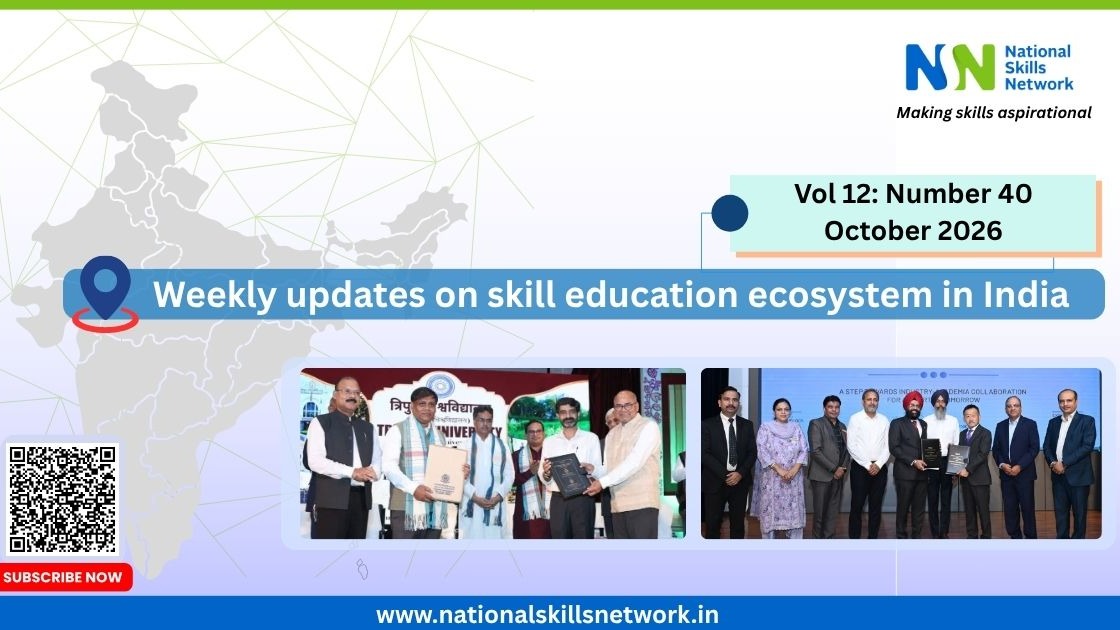
  • What’s happening across India’s skills and education ecosystem?This week’s updates cover ITI modernisation, industry partnerships, international skill collaborations, emerging technologies and workforce readiness.NSN is organising a webinar on “How Can We Build Employability Into Everyday Teaching and Training?” on 15th October, exploring practical ways educators and trainers can integrate employability into everyday teaching and training.Explore this week’s updates - https://nationalskillsnetwork.in/newsbytes-skill-education-6-oct-2026/#skilldevelopment #CSR #employability #education #ITIupgradation
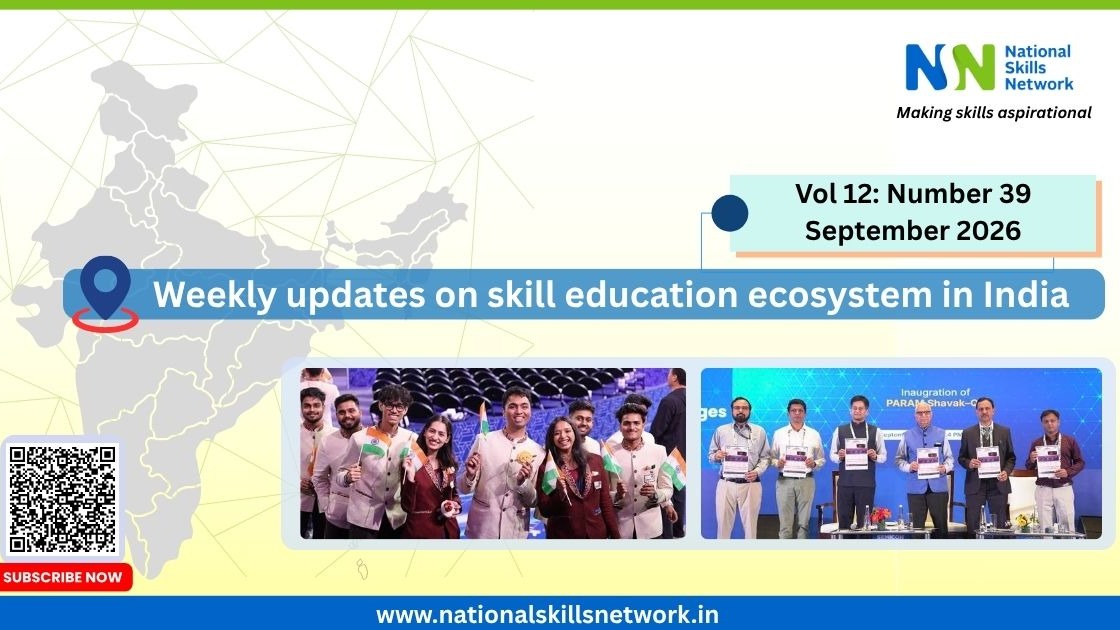
  • India secured 10th position at WorldSkills Shanghai 2026, with 6 Silver Medals and 20 Medals for Excellence.With its largest-ever contingent of 70 competitors across 63 skills, Team India showcased talent across advanced technologies, manufacturing, engineering, creative industries and specialised services.India also debuted in 11 new and emerging skill categories, reflecting the changing nature of skills and occupations.Read the full article to know more: https://nationalskillsnetwork.in/worldskills-shanghai-2026-india-ranks-10/#WorldSkills2026 #WorldSkillsShanghai #SkillDevelopment #Skills #SkillIndia
  • From Screens to Skills | Ideas from Mahatma GandhiOn the occasion of Gandhi Jayanti, we explore how Mahatma Gandhi
  • What’s shaping India’s skills and education ecosystem this week?India ranks 10th at WorldSkills Shanghai 2026, while rural youth are set to begin skill training under DDU-GKY 2.0. Karnataka has also introduced AI as an NSQF-aligned vocational subject for Classes 9 and 10.The latest updates also cover ITI upgradation, semiconductor and emerging technology skills, industry partnerships, and an FICSI RFP for impact assessment of food processing skill development projects.Explore this week’s updates here: https://nationalskillsnetwork.in/newsbytes-skill-education-29-sept-2026/#skilldevelopment #education #CSR #WorldSkillsShanghai2026 #RFP
  • Exciting internship opportunities at NSN! Apply now#internship #applynow #hyderabad
  • How can skill finance make job-oriented training more accessible?Skill finance can help bridge the gap between training, financing and employment by making job-oriented programs more accessible to learners who may find it difficult to pay upfront.In a recent conversation, Dr. Madhuri Dubey, Ph.D, Founder-Director, National Skills Network, speaks with Ms. CA Vinita Jain, Founder & CEO, Lakshya Skill Finance, about job-linked financing, AI-enabled underwriting, the role of training institutions, and the need for a more sustainable skilling ecosystem.Watch the conversation to learn more: https://youtu.be/YMgS95NMtkY?si=Pb4wWemMfaSVvt-o#SkillFinance #SkillDevelopment #SkillIndia #SkillsForJobs #YouthEmployability #FutureOfWork
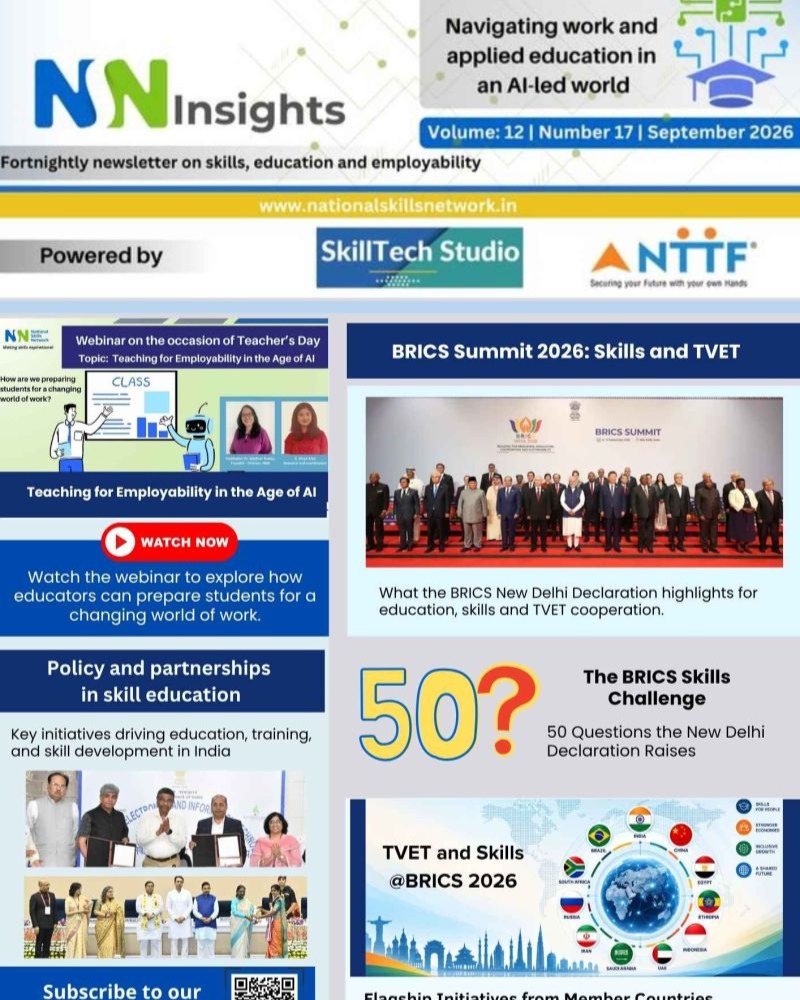
  • Here is the latest edition of NSN Insights, bringing together key developments and perspectives on skills, education and the future of work. This issue looks at the BRICS Summit 2026 and its focus on skills and TVET, along with the New Delhi Declaration, flagship initiatives and 50 questions for the skills ecosystem.Also, explore more about Teaching for Employability in the Age of AI, India’s participation in 11 new skills at WorldSkills Shanghai 2026, the evolving telecom sector, and more.Read the latest edition of NSN Insights: https://sendy.nationalskillsnetwork.in//w/380grSCH2763cYr2HalMjGvA#skilldevelopment #BRICSSummit2026 #TVET #Employability #education

About us

National Skills Network (NSN) is a consulting organisation based in Hyderabad, India, contributing to India’s education, skills and workforce development ecosystem through advocacy, research, knowledge management and policy implementation.

To know more about Our Team: Click here

Address

NSN Digital Solutions Pvt. Ltd.
CIN: U74999TG2020PTC147299
MSME: UDYAM-TS-09-0086473
Gachibowli, Hyderabad – 500032

Email us: contact@nationalskillsnetwork.com

Important Links

  • Conversations
  • Perspectives
  • News
  • Skill Development e-Magazine
  • Resources
  • Our Team
  • Our Clients
  • Partner with us
  • About us
  • Advertise with us
  • Content Disclaimer
  • Privacy Policy

© 2026 National Skills Network Content licensed under CC BY-ND 4.0. Commercial use requires permission.

loader
No Result
View All Result
  • Home
  • Conversations
    • Industry Conversations
    • All Conversations
  • Perspectives
    • Education
      • Higher Education
      • School Education
    • Emerging Technologies
      • AI Skills and Education
    • Government Initiatives
    • Industry
    • Industrial Training Institutes (ITIs)
    • NEP 2020
    • Skill Training
  • News
    • Latest Updates
    • News Archives
    • CSR and ESG in Skill Education
    • Skill Development e-Magazine
    • NSN PDF Newsletter Archives
  • Videos
    • Explainers
    • Panel Discussions
    • Student Stories
    • Video Conversations
  • Resources
    • Apprenticeship
    • e-Books
    • Resources
    • Success Stories
  • Events
    • Workshops
  • About us
    • Our Team
    • Our Clients
    • Our Services
    • Privacy Policy

© 2026 National Skills Network Content licensed under CC BY-ND 4.0. Commercial use requires permission.

    Team NSN

    TeamNSN

    Hey, how can I help you today?

    Click to start chat