This is the fourth part of the report on the 7th CII Global Summit on Skill Development 2016, held on 9th -10th November at Hyderabad.The report is presented in 4 parts. Click here to read Part 1, Part 2 and Part 3. In this part we present a summary of the proceedings from sessions, 3 and 4 on the second day of the event.
Session 3: Skilling for Golden Telangana and discussion on Telangana State Draft Skill Policy – Industrial growth of any state – 3 critical parameters, should have a conducive business ecosystem, physical infrastructure, availability of skilled workforce. Achievement in IT industry – The session was chaired by V Rajanna , Vice Chairman, CII Telangana and VP and Regional Head, TCS.
Session highlights: Key points discussed in the session
- Initiatives and plans from Telangana government in skill development and entrepreneurship
- Need to increase collaboration between the industry and the government
- Key focus areas of the draft policy on skill development from the Government of Telangana
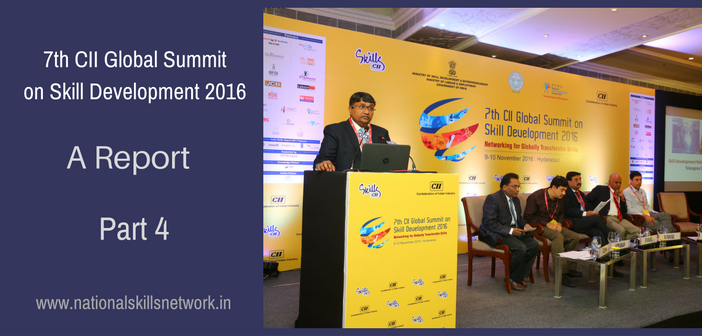 Mr. Sujiv Nair, CEO, TASK
Mr Sujiv Nair reflected on the commitment of government of Telangana for the development of the state with several policy and infrastructure reforms. This included reduced power cuts, rejuvenation of lakes, provision of clean drinking water and most importantly promote ease of doing business. He exhorted the audience to review the draft policy and share feedback and suggestions to make it inclusive. He provided the backdrop of the draft skill development policy of the state by underscoring the following points:
- As per the NSDC study, there are several potential sectors in skill development in Telangana. This includes IT- ITES, BFSI, Construction, Manufacturing, Healthcare, Pharmaceutical, Agriculture and allied services
- 50 lakh jobs will be created over next 5 years
- There is a renewed focus on enhancing skilling and impetus for skill development policy
Mr. B P Acharya, IAS, Principal Secretary, Department of Planning, Government of Telangana
Mr. B P Acharya informed the audience about how the policy is based on learnings from the other states and other points like:
- The policy reflects the needs of the industry and is a platform for interfacing the industry
- There will be 2.2 crores working population (1.51 available workforce) and they need appropriate skilling
- The need to identify skill gaps and mismatches and collaboration between the industry and the government
Mr. B. V Papa Rao, Special Advisor to CM, Government of Telangana
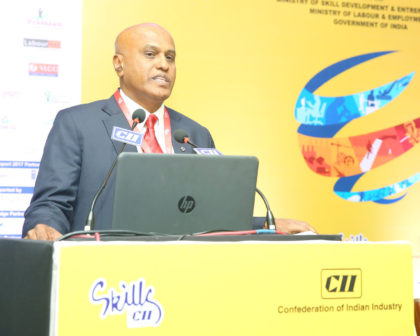 Mr B. V Papa Rao presented the details of the draft Skill Development Policy and said that the policy has essentially adopted the National Policy. The only point of disagreement was with regard to establishing skilling universities. Other highlights of the draft policy include:
- Regulating the engineering colleges and balancing them with skill development initiatives
- Policy advocacy for different courses, internships, apprenticeships, placement cells
- Constitution of different pillars to deal with clusters of industry sector that will follow NSQF
- Need to have active participation of sector skill councils at the state level
- Instead of creating a new ministry for skill development, the organization would work with multiple CEOs to head the pillars; there would be a mission directorate, supported by a unified website
Session 4: Policy enablement through quality and inclusion. How can the industry come forward and engage with the reforms? Challenges and expectations from the industry, and best practices for implementation. The session was chaired by Mr Pramod Bhasin.
Session highlights: Key points discussed in the session
- Making skill development inclusive by recognizing the contribution from workers
- Need for quality infrastructure and trained faculty
- Include more women in the workforce through appropriate skillingIncorporate cognitive skills as a part of the curriculum
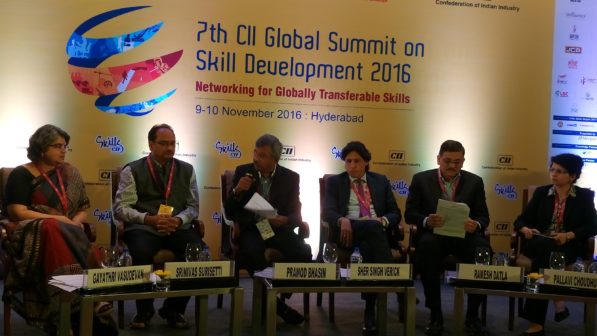
Dr.Gayathri Vasudevan, CEO, LabourNet
Dr. Gayathri began her presentation by highlighting the lack of quality in mainstream education and how reforms could bring education and skilling closer. She emphasized on other important aspects such as:
- Skilling quality or vocational quality has to start with educational quality. And it cannot be achieved just by emulating different models of the world.
- The biggest challenge is the need for strengthening the quality of education with quality of skills where they have to meet.
- There is a shortage of skilled people across the world; we have a very fractured system where we do not recognise the workers.
Dr Srinivas Surisetti, Chairperson, Academic Program and School of Vocational Education, TISS, Hyderabad
Dr Srinivas Surisetti’s perspective on policy enablement through quality has some key elements for creating a sound framework. This includes:
- Large- scale and demand-driven skill development is the need of the hour
- Quality infrastructure, and faculty are the two key requirements to meet the market demands
- Any placement or job should assure them that they can grow and learn in the sector they are placed in
- While we talk about technology and mobilisation, the infrastructure should come in first.
Dr. Sher Singh Verik, Deputy Director, ILO Country Office, India
Dr. Sher Singh clearly re-emphasised that quality has become a big force for skill development reforms around the world. This is mostly manifested through Qualification Packs (QPs) or National Occupational Standards (NOS). Besides, he laid stress on other aspects like:
- Industry involvement is critical. Yet apprenticeship doesn’t work because of the lack of awareness.
- Non-availability of trainers can become a huge bottleneck; remuneration for trainers is very important.
- India has the lowest inclusion of female workers in the workforce, and it is necessary we make this transition.
- Skilling school dropouts is difficult, so we have to level up the formal education so that drop outs decrease.
Dr. Pallavi Chaudary, Associate Fellow, NCAER
Dr. Pallavi Chaudary dwelled on how our education system has been exclusionary and has created limitations like reading and arithmetic skills. The industry needs people with basic cognitive skills. We need to look at skilling in a more comprehensive way but not individually. Our skilling policy does not actually focus on all the sectors.
- Many states of India have been ranked the lowest globally in a cognitive test conducted on 15 year olds
- In India, we do not have a culture of asking questions – both open and close ended.
- Non-cognitive skills reinforce cognitive skills, hence we need to impart both.
Session 5: Employment Solutions for Global Growth: Mobility of labour is a natural phenomenon as the world becomes a global village. How do we address the imperative to follow norms and standards? The session was chaired by Ramesh Datla, Chairman, CII Southern Region and MD ELICO Ltd
Session highlights: Key points discussed in the session
- Migration related issues for international employment for low/semi-skilled, medium-skilled and highly-skilled workforce
- Need for adherence to international standards and labour regulations
- Socioeconomic benefits of skilling as per global standards
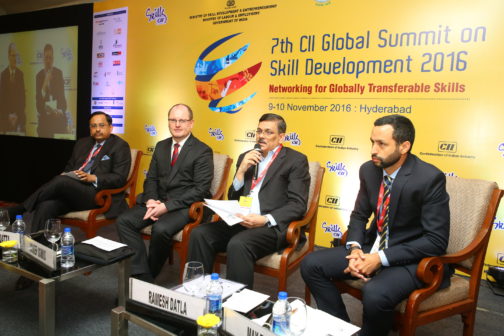 Mr. Ramesh Datla presented the following points before the panelists
- Status of India in terms of employability by 2020
- Surplus 47 million employable youth and rest of the world will have 35 million shortage
- With reference to McKenzie Report in high-level skills, we have 6 million surplus; in mid-level skills, there is a shortfall of 13 million and in lower-level skills there is 27 million surplus
- The question that needs our attention: Are we training them for India or the world?
Mr. Max Tunon, Migration Specialist, ILO
Mr. Max Tunon began his talk by categorizing migration into two: high skilled and low or semi skilled. For the low and semi-skilled workers, the competition for labour market is between two countries (competition among countries that attract high, middle and for lower skills), for example, Asians competing for labour market in Gulf countries). To mention the key points from his talk:
- According to ILO, low and mid level workers are more vulnerable to labour rights abuses; migration is not fully capitalized and realized and learning gained from abroad is not utilized when they come back to countries of origin
- Some pilot projects are in progress at India, Sri Lanka, Pakistan, UAE
- It is important for domestic issues to be addressed, otherwise they get exacerbated in international labour market
- The minimum or referral wage has to be increased to attract candidates
- Lack of labour market information and this need immediate attention
- Regulation of recruitment industry both at countries of origin and destination is based on the ability to pay the low and middle levels
Mr Volker Schmid, Head of Asia Pacific, Festo Didactic
Mr. Volker Schmid enlightened the audience about how the need for training standards at the low levels of skilling. Other points from his talk included:
- The diversification of mobility and migration in different countries
- At the top level of skilling, international standards and assessments are clearly defined
- At the low level of skilling, there is a need to define international standards, criteria, quality, income levels
- There is a need to impart cultural skills and this can’t be fulfilled through short term training
Mr. Ambarish Datta, CEO, BSE Training Institute
Mr. Ambarish Datta described that reasons for skilling people in India for international jobs and how it had many socioeconomic benefits. Implementation could be an issue since many countries may not have the capacity to absorb the migrants; there could be geopolitical issues. To mention other aspects of his talk:
- Lot of effort is needed to meet global standards, norms, international regulations
- We need identify the benchmarks and integrate local and global standards
- Certification gaps need to be fixed before transnational standards by testing application of knowledge rather than recall
- Certification is perceived as a binary – an exit or an entrance for recruiter to hire; results are also in binary format – it’s either a pass or fail. This leaves out those who perform in between these two ends.
Conclusion: In the two-day deliberations, the agenda for globally transferable skills was interpreted and discussed from various angles, by a wide range of stakeholders. The international experience and know-how will definitely help in conceptualizing and driving skill development as a demand-side initiative, while support for entrepreneurship can strength the supply chain. While meeting international standards is essential, there were valuable inputs on using technology in training and making skilling aspirational for the youth and industry through better incomes, higher productivity and higher quality orientation.
This report is prepared by National Skills Network – NSN, official online media partner for the 7th CII Global Summit on Skill Development, held at Taj Krishna, Hyderabad on 9th and 10th November 2016. To know more, visit: https://nationalskillsnetwork.in